45. Craig Goodwin, Co-Founder and CEO of Bleach Cyber: Imagine Cybersecurity, but not Complicated
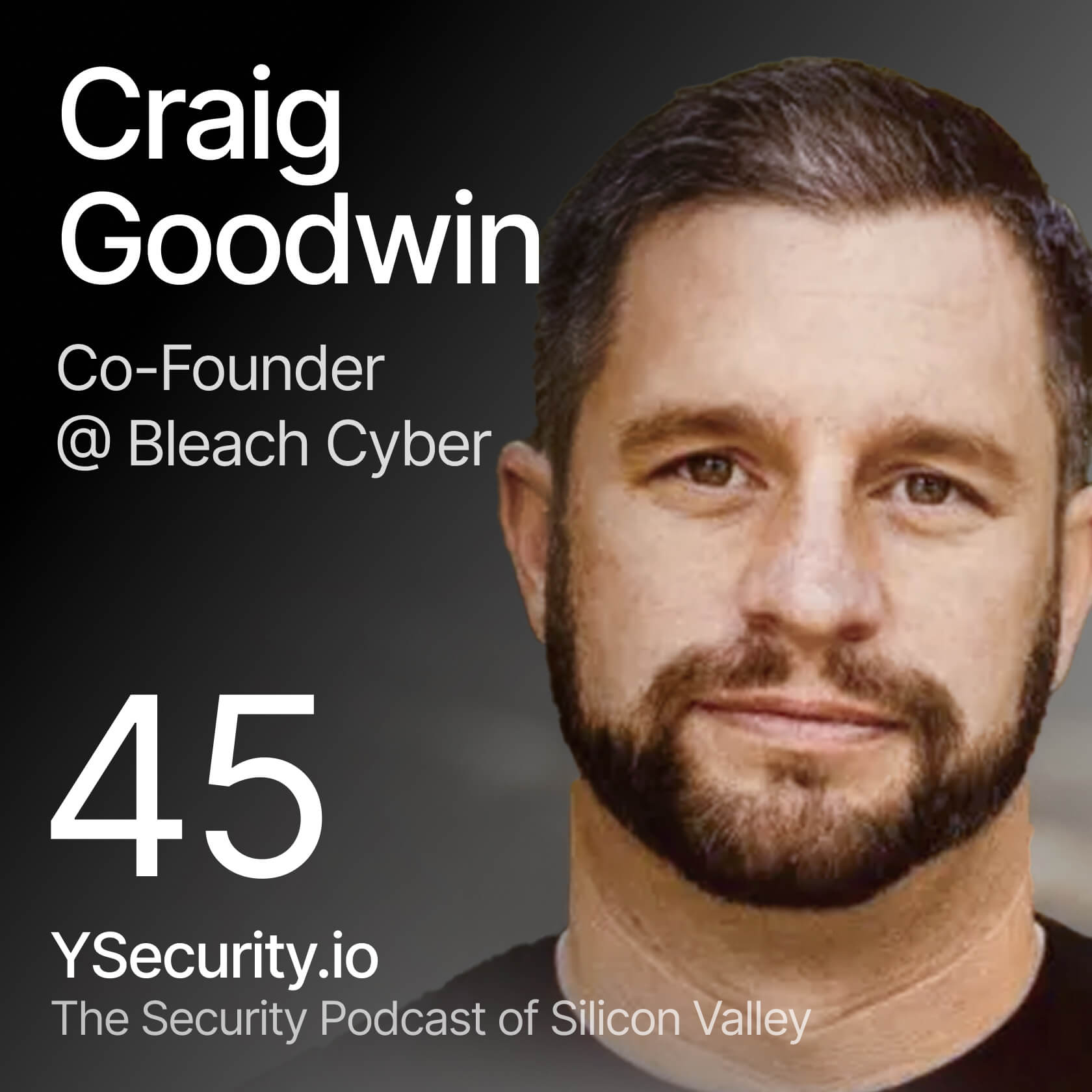
Hello, everyone, and welcome to another episode of the Security Podcast of Silicon Valley. This is a Y Security production, and I am your host, John McLaughlin. I'm here today with a very respectful guest, Craig Goodwin, the co-founder and CEO of Bleach Cybersecurity. Welcome to the show, Craig.
Where are you calling it from? I'm in the UK, so south coast of the UK, by the beach, about 90 minutes from London for all you Americans. Thank you for the context for all of us Americans. It sounds beautiful, though.
You bring a lot of great experience to the table. Would you like to share a little bit about your background with our listeners? Yeah, sure. So started off in the military in England, in the intelligence side of the military.
And when you're doing that, there's two roles. One's running around deserts with guns, and the other one's doing cybersecurity. And unfortunately, quickly realized that no one cares about the running around deserts with guns when you come out into civilian life. So I had to lean on the cybersecurity bit and found my way.
Thank you for your service. Oh, thank you. I appreciate that. Only Americans say that.
In England, everyone's too cagey. Oh, well, that's unfortunate. Yeah, I love that. When I come over to America, you guys say that a lot.
Thank you. I appreciate it. Yeah, so did that and then fell out of that when chief security officer was just becoming a thing, really. And then spent the next, I don't know, I always get this wrong.
I'm going to make it up 15 years or something. Jumping between gradually larger chief security officer roles. So started with Monster Worldwide in Boston. Went to CDK Global, which is a 12 billion automotive tech firm in Chicago.
And then ended my corporate career at Fujitsu. And then always wanted to do startup. So founded my first startup in 2019. Did that for a few years.
Congratulations. Congratulations. That's crazy and insane and fabulous and spectacular all at the same time. Mad life.
Absolutely mad life. I describe it now as like equal parts terrified, equal parts really excited. And that never really changes. It's just the balance.
So you're comfortable being uncomfortable. I think you have to be. There's no choices there in this game. No, not at all.
Yeah. And then they did that for a couple of years and then founded Bleach. So like Bleach, Bleach Resist Adventure to always be really passionate about trying to find a way to help the smaller end of the market. We as CISOs, we, even with our tens of millions of dollars, it's really hard to protect our businesses.
So always felt sorry for the supply chain, always felt sorry for those smaller businesses and just couldn't get my head around how they were going to protect themselves. So always had that passion in the back of my mind. And year and a half ago now, so I'm like, it was crazy fast. Started out on that journey to find a simple, easy, cost effective way for small businesses to get secure.
And here we are. Amazing. Well, thank you. Thank you for sharing.
Thank you for all the contributions to the security community. You clearly are a security person. I'm curious, is there a story or something that pulled you into security? Yeah, well, I think my kind of unique, I don't know whether it's unique, my most, the thing that interests me most about security is definitely, I don't even like it because it sounds a bit of a cliche nowadays, but like the human part of security.
I think my background was on the human intelligence side. So I always just think everything's driven by people. I lead like that. I run my businesses like that.
Everything is about people. And it doesn't matter how technical a subject is. I love it. People are what matter at the end of the day.
So it bleached. What do you do exactly as co-founder or CEO? What's your day look like? Yeah.
So me and Steve, we split well down the middle. I think we complement each other really well. We grew up together, so we've known each other forever. It was really super important to me coming into this business that, and this again, maybe I shouldn't caveat this.
I just sound really English, but I caveat everything with it sounds really cliched. But I just want good people around me, but I just want good people around me and I will work with good people. And Steve is one of those good people. I've had some bad experiences in the past, and I wanted someone to trust who was just a great person to be around.
And Steve leads product and development, which is all the techie bits that perhaps aren't really my forte. And I do everything else. So lead the kind of business side of Bleach. And together that makes a great partnership for us because he goes off and hides and puts his headphones on and does the development and leads the development team to build an incredible product.
And I go and just sell it. That's how we've done that dual tag team role for the last year. And it's worked really well to this point. Yeah.
And then as a business, as I explained, we're focused on small businesses. So we made it our absolute mission just 12 months ago to really make cybersecurity simple. How could we dumb this stuff down and make it as easy as possible for people to get secure without needing one of us constantly and telling them how to do things? I like in the analogy that I love is like Asana for project management, right?
You take Asana for project management. Who goes and hires a project manager to run Asana? You don't need it, right? Because it's so simple to use that you can run your own projects on there.
Now imagine that in security. Bleach is that for security. You don't need a full-time CISO because you can run security without the need for that. I caveat this again with when you're a small business, right?
I'm not talking about enterprises here. You want to find a way where you can make it simple, cost-effective, and really easy to use. And everything we do down to the small things, me and Steve constantly remind ourselves in the development team, make it simple. How simple can we make it?
Make it easier. And that's our mantra. And that's going to be our mantra for many years to come. That sounds so enticing.
I'm just, I'm as a security operator myself and my day job is looking at dashboards. I'm looking at tickets. I'm looking at issues that come in and there's a lot of complexity there. I understand where the complexity is coming from.
Like all these great vendors who specialize in different things, like contributing back to the security of an organization, but with startups, with small businesses, you have to find that nice balance, right? Yeah. And I think you've got, you've got a real opportunity with those as well. So we all talk about like security by design and I've written security for some of the largest businesses in the world.
So I know it's not as easy as resetting. So even if you were in the new CISO, you're like the last guy did it all wrong. Here's what I'm going to do. But the reality is you've got 30, 40, 50 years of history built up in a business and you can't just reset.
Whereas with a small business, the beauty of that environment is you can, you've got start from scratch. You can build from the basics. You can do the basics right from the outset. And that, that's always been the aspiration of bleach is to do the basics.
Why do them proactively and make everyone secure by design. If that's not too much of a cliche phrase now. No, it's, I don't think it's cliche. I like things that are secure by design and simple by design.
And that's actually very difficult to achieve. It's very easy to have something like unwieldy complex and just a giant plate of spaghetti and very quick to come up with and messy around the edges. And beauty is when you can not remove anything from the picture. Right.
And without losing functionality, like pull something down to its bare component. Isn't there some kind of really cool quote, insert quote here that I can't go and Google quick enough, but like something about. Yes. Yeah.
Something like that. The most complex problems create simple or something. I don't know. Oh, your founder, your co-founder, your co-founder there.
Leach is a childhood friend. So we went to school together when we were about eight years old and onwards, we served in the military together and we've worked in multiple large businesses together with him as my two IC. So yeah. Peers in the military or one of you was the commander and one of you.
No. So we were in completely different regiments. Oh, completely different. Oh, I see.
We knew each other from school. He was a tanky actually, which you would love me to say. So he was driving tanks around the battlefield while I was pretending to be a civilian and involved. In human intelligence side.
I had no idea that the army did human intelligence. Yeah. Yeah. Branch does.
Yeah. But in fact, most of the British, we're so small in the British army that there's bits of all the army do human intelligence. Not like you guys who've got a hundred thousand people just dedicated to one job. We don't that love during the British army.
Unfortunately, you mean you don't have that inefficiency. No. Oh, I'm sorry. I'm sorry.
We're not going to get political or we don't need to get political. I'm pretty sure the someone will correct me on this, but I'm pretty sure the United States Marine Corps is bigger than the entire three services, the army, air force and navy in the UK. So if I'm a small business owner, one of the questions that I might be grappling with is like, when is the right time to start prioritizing security? How do I know when is the right time to start moving forward and thinking about some of these like questions?
Maybe I have a FAS. Maybe I'm a service organization. Is there a framework to help me think about when to start taking these things security or when to start taking security a little bit more up the chain on my priority list? I know it's a priority, but it's in competition with other things, of course.
Yeah. And I think that was a more difficult question previously. I think when it was really complex to get secure and to do these security things, and I think that was a much harder question. And even I definitely sit on the realistic side of the CISO group.
I would say you don't have to have sharks with freaking laser beams when you're early. You don't need NDR day one. Right. But it's always about taking the basics.
Right. And I think when you've got tools like Bleach that help you to do that, it makes it very cost effective and very straightforward. So I think with the opportunities like the Bleach platform and being able to integrate things, one of the things that we were, one of the theses that we built up when we built Bleach was that actually that tech stack you're already using, the Amazons, the Googles, the Microsofts of the world. Thankfully, because they're huge, they've spent an awful lot of money on security capability.
The one thing that they haven't done necessarily is make it very easy to use. So that's what Bleach does. So you don't have to have a lot of investment in now. You don't have to put a lot of resources in now.
You can actually leverage what you've already got to do security better. So I would say now is the time to be able to do it much earlier than you perhaps you would have been able to a few years ago, five years ago, whatever the number is. But it's always worth considering. I think now, I think the great thing and the great job that the industry's done generally is it's become part of the parlance.
I don't think there's many startup founders, particularly now in technology that don't think about whether they do something or not is a different question. But I don't think many that don't think about it at all now. So actually, then it's finding the right option for that. And people like Bleach and our competitors that are popping up are making it much easier to do that and much more cost effective to do that.
So yeah, I would say now is the time. Now is the time. Do you feel like the space is being commoditized? So I'm assuming.
Yeah, security. Security tooling, security vendors. I think what, I think there's a lot, maybe this will get me canceled, but I think there's a lot of positivity to come out of a bad economy, right? I couldn't agree more.
Thank you. Thanks, Jeff. Of course. It's a filter.
You're just like, economy goes down, things get tough. Like all of the crop just like crops. 100%. And I think that's happened on both ends.
Like it's made my life this cool for the last year. Startup founders all over the place. It's really tough. So it's not just, this is a personal thing.
I've suffered through this as well. But I do ultimately think it's a good thing from both sides. Like I think on our startup side, it's made the stronger businesses bubble to the top a lot. And we'll continue to do that over the next year and two years.
But then on the enterprise side, it's definitely pushed people to be more frugal. It's pushed people to think harder about those investments that they're making and where they're putting their dollars. Now led a lot to like platformatization and all businesses thinking about creating these platforms that do everything and the golden bullet and all this kind of stuff, which is going to take a long time to play out. But I think the most positive is thinking about the investment, focusing on those basics.
Do you know how, again, let's talk about how many people are going to email me off the back of having this conversation. But the next CISO that says to me, generative AI is my biggest risk in the organization when they're not doing patching very well is wait, let's talk about priorities here for a second. And I think, and then where that money goes as a result of that prioritization, as a result of that risk. I think that's made us think hard about that.
And that's why I believe we're getting so much interest in bleach right now is not just because it's suitable for small businesses. But I'm telling you now, there's a lot of businesses further up that chain that will also benefit from the basic that we're doing, whether they admit it or not. I think there's been a big reset. And I think that's a relatively positive thing in general.
It's funny you use the expression, the golden bullet. That's the first I've ever heard of that one. I'm still looking for silver bullet. Silver bullet.
Yeah. Oh, and the other thing is you don't want to jump on the AI generative AI bandwagon. There's definitely a time and space for that. I think, so here's my theory on startups with AI.
I think we're getting to the point now where if that's your differentiation, then it's a worry. I think every business should be using AI in some capacity. We're using air bleach. Everyone using it for multiple different use cases right now.
But if your only differentiator is that you're AI, then I think over the next 12 to 24 months, you're going to have to shift, quite frankly. Because I think everyone's using it. Everyone's doing it. But you've got to have a different differentiation because of that.
That's true. Yeah. Yeah, I can see that. I absolutely can see that.
Let's fast forward into the future. And I will let you decide how far into the future we'd like to time travel here. But could you help us see what success looks like for you and your team at Bleach Cyber? Yeah.
So I've said this from the beginning. And where we'd like to get to is that the Bleach becomes the de facto cybersecurity solution for small businesses and startups. So a bit like when you're building a business and you look at one of the clouds and you're like, well, it's AWS or it's Azure to build my SaaS platform. You look at insurance providers and you go, I need to have this.
I need to establish my business. I'm going to do this. Bleach just becomes part of that. Bleach is just the vernacular or the verb for securing a small business.
And I think that's ultimately where we want to get. When people look at it, they don't think of cybersecurity. They think I've just bleached my business. That's why it's clean.
That's why Cyber Hygiene is included just as a fundamental part of building and running and operating any startup or small business. I love it. How far into the future did we travel though? Six months.
Ambition. I love it. I'm kidding. Let's be reasonable.
Like three to five years. Let's say that. We were somewhere in there and I think. Three to five years.
Yeah. I think we get to a point where Bleach is the health checkmark. It's that blue checkmark for cybersecurity that everyone looks for when they're doing M&A or when they're investing or when they're going to grant insurance or when they're going to give a contract from a big enterprise by a CISO. They'll go, oh, you use Bleach?
Let me see your Bleach scorecard. Okay. You're good. What's your go-to-market strategy there at Bleach?
You've got a couple of. You're mentioning investors. You're mentioning cyber insurance. Those are really interesting maybe go-to-market partnerships.
Yeah. They're all routes to the smaller businesses, I think. What we've seen, so our predominant customer base sits in kind of two areas now. Number one is direct B2B small businesses.
So we've got 500 plus small businesses right now that are utilizing Bleach to monitor, control, assess, remediate security risks within their environment. So that's number one. And we're servicing those customers every day. Number two is through managed security service providers and security services businesses.
So effectively what we're doing is empowering virtual CISOs, security consultants to have in their hands a really powerful set of security tools that they can leverage to assess, operate, and maintain those offerings for their customer base. So imagine a world like we're talking to a consultancy this week. Their consultants are using like a bit of flimsy script that they've used in an Excel spreadsheet that they walk into a customer. They run the script on their AWS environment and they get some results dumped out in a messy Excel spreadsheet that the consultants got to spend hours then messing around with.
Imagine a world where you've got a beautiful UI where you can go and hook up their cloud within minutes, get assessment results within seconds, and deliver those results, help them to risk manage, help them to remediate. And your customer can see all this happening as well. Like MSSPs and security services businesses just see that this product is simple, but really helps them to drive better quality outcomes for their security consulting. Amazing.
Here at YSecurity, we offer an on-demand security team and we specialize in ambitious B2B companies that are trying to raise their operational and security maturity level. Oftentimes it's business driven for Slack 2, ISO, FedRAM, or even just, oh, we'd like to prepare ourselves to go public. We've got all the standards built into Bleach. We've got a nice scorecard functionality is now where you can share that scorecard with any of those people you want to build trust with.
So that's why security should be powered by Bleach. So what's the best day that you've had so far in your journey at Bleach Cyber? Wow. That's a great question.
The best day. I think it was super early, actually. I love, and it's hard. I said at the dot, I think equal parts terrifying, equal parts super exciting.
And that, that gets everything I'm saying. But I think those really early days are just so exciting. Me and Steve sat on our own inner spaces in the UK, just whiteboarding and just drawing things and going, look what we can do here. And I think just, and even now, like that's still continuing two years in.
I hope it's still there five years in, 10 years in, whatever we're doing. But just that excitement about building that. And I remember that first day sat in spaces, me and Steve sat there going, what's this going to look like? And then the second one would be sat in a Starbucks with my wife right after I'd left my last startup.
Sat there having a coffee and I was like, right, can't sit on my ass anymore. Got to go and do something. What's the next thing going to be? Sat in Starbucks.
And I said to her, right, I need a name. But the trend at the moment is names have got nothing to do with what they're doing. So like toast for sale. Yeah.
What a toast. Fine. Okay. Right.
And I loved that. And I said to my wife, I said, look, you're, you don't, you couldn't care less about cyber security. Like I want to build something that is, it's all about cyber hygiene. It's about keeping the business clean.
It's about sweeping things up and just making sure that you're hiding your daily routine is really good. And she was like, bleach. And I was like, so I registered the bleach corporation in the US, built, bought the domain bleach cyber. And we were off and running.
And yeah, I think that was just one of those moments where I was like, this is going to be epic. You capture that moment with a little picture. Actually, no. Which really is me now.
So we might go. We'd have to go. We'd have to do it again. We could use generative AI to recreate the moment.
The moment bleach was. That's great. In a Starbucks. As Craig was registering the domain.
Domain. Yeah. 100%. No, that's amazing.
No, thank you for sharing. That's really special. It's those little moments that make all the risk worth it. What about your most challenging day at bleach cyber?
Wow. Wow. There's been a lot of those. It's been a lot.
Yeah. I understand completely. The roller coaster goes up and it goes down. It goes massively up and down.
And I think that's true of any startup. Resilience. Absolutely key. I think.
Let me try and think. I think probably early days again. Like probably having an idea. Having funding.
Is probably one of the worst things. You don't always need funding. Most people aren't in the luxury position. Where they've got millions of dollars.
It's a way that they can just go and do it themselves. It's a few money. Not many people have that few money. And you want it.
But you haven't got it right now. So I think having that. I think generally speaking. It wouldn't be one day.
But I think having those early days. And it's changed a lot now. Where people don't believe in what you're saying. And you have to be incredibly resilient to get through that.
One of the things that we've faced. And there's definitely changing attitudes now. But from a funding perspective. VCs in general.
We're always very reluctant to back. SMB focused plays. Right. The security market is so traditionally focused on the enterprise.
That the majority of investors. As soon as you say. I'm focused on SMBs or small businesses. They're just immediately like.
I'm not sure we can do that. And I face. Tech please. Yeah.
Exactly. Yeah. And I just face that a lot in the early days. And we continue to in some camps.
But being said. The market is so huge. I welcome some of the competitors that popped up. I think it adds validation to the cause.
And we're seeing a lot of people pop up now. That are focused on that smaller space. And trying to do something relatively similar. Which validates.
Vindicates what it is that you're saying. And I think. Hopefully gone are the days where everyone goes SMB. No way.
And now actually. The size and scale of that opportunity. Is definitely huge. So.
So yeah. I think that's the hardest thing. Is just sticking to your guns. And being resilient enough.
But also. Not being egotistical enough. That you think everything's right. There's that tricky balance of.
I think my idea is right. But I'll. Some of that feedback. And it'll change as it goes.
But. At the same time. Sticking to your guns. I think that's a really important balance to strike.
That's awesome. The balance between humility and confidence. 100%. Yeah.
What was your early funding story? Did you have angels? Did you have pre-seed? Did you do seed?
Did you do friends and family? Or did you just sell hootstrom? Yeah. Yeah.
So. So. Like crazy founders. We.
I was really lucky. So I had a couple of really close mentors of mine. Investors slash angels that had seen me through the journey of my last startup. And I was lucky enough to be in the position where when we spun off or when I started to build Bleach, they were like, well, what are you doing next?
Kind of thing. So. So we would need to have the support of, of a couple of early people who just saw the value and saw I'd been doing over my career and were almost blindly backing me into the next thing. We've got us started.
And now I think it's about loads of lessons over the course of the last year. I think 2023 back to the finance thing has taught us about frugality and testing things and building things frugally. I think gone are the days where it's like growth at all costs. It's not that anymore.
And now about it's about conservative growth and considered growth. So we were lucky enough. And I think this is a juxtaposition to my last startup. We were lucky enough to have the opportunity to take six months to actually build a really solid product in the background.
And one of the lessons I learned last time was trying to build the plane while you're flying it is really fricking difficult. So if you can raise the money and raise the capital to give yourself the room to be build at least an MVP that's solid enough that people can use it, that's a really important first step. And doing it that way around just made our lives, I wouldn't say it was easy, but easier this time around that we had like a solid product and a solid foundation, thanks to Steve, who's built that, which meant that we started from a really solid foundation. And we didn't have that trying to sell, trying to build, trying to sell kind of thing that was going.
We do have that. Wow. That's good. Not problem, but foundation to build from.
That's spectacular. So how big are you guys today? Yeah, still suitably. We're still in the free seed.
So, yeah. So we've got an incredible outsourced development team. But then on top of that, it's me and Steve and just a few others right now. So a bit of customer success, a bit of support and some internal developers.
And the rest is all outsourced. So we've grown to an incredible rate in keeping it relatively frugal. And you mentioned 500 folks using your product and 500 enterprises, FMB using your platform. 500 companies on the platform.
Well, 500 plus we're growing every single day. So, yeah. Wow. 500 plus companies right now.
And it's super exciting there. And the great thing about being early is they're giving us feedback every single day. So like the amount of data that Steve's getting and I'm getting about where we should go next and what we should build next. People used to say that to me and I used to be like, yeah, how'd you do that when you're early?
You're never going to have enough feedback to do that. And we're in this amazing position where we're getting that every single day and young and agile enough that we can actually do it. Execute against it. Not disappearing into some bucket of recommendations that we never look at.
Like it's genuinely influencing the road, which is really exciting. I love it. Your suggestion box doesn't feed into a paper eating machine and shredder. Shredder.
Shredder. No, Steve's incredible at that. And we've been getting feedback from day one, but now it's just flooding in. So everything from like where our integration should go next, like what we should be protecting next, what the dashboard should look like.
All that stuff is just coming from multiple different angles now. We've got incredible advisors. We're building a kind of a like CISO advisory board as well. So chief security officers, not by the way, because, which is different from other cyber companies, not because they're our customers, but because we want to build the head of the CISOs into the platform.
So they're effectively facto advising our small businesses by helping to drive the roadmap of the platform. You know, so I don't know what the number will be in five years time when we get to that blue health check mark, but, you know, built by 10, 000 CISOs or something to help your small business would be a great tagline. When you're thinking about expanding the business and expanding the team, I know you mentioned some outsourcing, but do you have a favorite interview question? Wow.
That's a great one. I think my favorite interview question would be nothing to do with work. It would be. I love these sorts of questions.
Oh, I think mine would be somewhere along the lines of what's your favorite hobby and why are you passionate about it? I think to my philosophy on basics, I think what people do in their spare time and why they found that thing and what it does for them is so cool. So I always would never ask someone to answer something that I wouldn't answer myself. So for me, it's like road cycling.
Like I, I've road cycling is my meditation. It's my physical fitness. It's my space. It's my thinking time.
It's not just a go ride your bike for me. It's everything to me on a daily basis. And that's why I'm so passionate about it. And I think what comes back from people when they answer that question says a lot about who they are and what's important to them.
I would also add less therapy for me too. I'm also into road cycling. Yeah. Yeah.
Yeah. Absolutely. So do you race? Do you, do you do distance to road cycling?
Like what sort of stuff? Road cycling are you? Race is loose. Like I did a sporty last weekend.
So I'll do four or five sporties a year. So that was like 92 kilometers in the UK. Two kilometers. That's, I'm trying to convert that in my head.
It's miles. Miles. That's really good. How fast can you do your 50?
I did three hours, five minutes, I think. Wow. That's incredibly fast. Is it?
Yeah. Yeah. And that's incredibly fast. Yeah.
For 50 miles. Yeah. Oh, great. Yeah, I did.
And, and I, I just love that. And it's not so much. I love competition with myself. So I'll go and do, you know, cause it's like a nice organized long ride, but actually I love my Strava.
I love looking at my own numbers myself. I love and just competing again. PR. I got a PR.
Yes. Same, same here, right here. That's spectacular. That's amazing.
It's important. And I think to have a little bit of time to disconnect from all the glowy screens and all of the intensity around building businesses and thinking about cybersecurity. Some of the best little ideas that have been built into Bleach have come in a moment. Steve hates it.
Cause I'll get back from a ride. I won't have bothered changing. I'll just dive straight on my computer. I'll call him on Slack and I'll be like, guess what?
I'm just still, let's be there. And there's, oh my God, what's next? But yeah, it's good. No, that's awesome.
That's spectacular. That's a really good question to ask folks. So you can get to the heart of like, where's the passion? Where's the fire with somebody?
It's important to have that. Have you, in terms of the next question, maybe you could share with our listeners a book or a movie and you read it or you saw it and it really changed the way that you see the world. Like it was profound in some sense. And it spoke very personally to you.
Wow. I really struggle when you put me on the spot. That's there's so many. I would say, so a little bit of an off-peat one.
There's one called, I love him. He's a fantastic author, a guy called John Ronson. He's from the UK, but he's an investigative journalist, interviewer, and he wrote a book called The Psychopath Test. And it's all about, yeah, it's all about a test that was created by psychologists.
I think in the eighties, seventies or eighties, there was how you assess someone as a psychologist, but sorry, as a psychopath. And it's different, 10 different constituents of what a psychopath is, but actually it's about him meeting some prisoners, meeting a lot of people in all different walks of life and essentially discussing who's a psychopath and who's not. And it just, it was just incredibly enjoyable, but also spoke a lot to a lot of my theories on psychology and I come from a human intelligence background. So I'm just fascinated by the way people behave and how we can be influenced and how different people react in different situations.
I, it just, an incredible passion of mine and anything, just because my military background, anything about the jihad or Al Qaeda or groups like that, not again, because of any kind of fascination with war or any of that stuff, but more about the human psychology. Like how did Nazi Germany happen? Like how do you get psychologically conditioned to join a group and just follow them blindly? It just fascinates me, human psychology and how people interact and react in different situations.
Is that what you studied in school? No, I joined the military straight out of school. So, so I, I went straight from early school into. You went right into practice and practitioners.
Right into experience. Yeah. And even now I'm a believer in that experience side and you can get so much from experience. So yeah, I went almost straight into human intelligence.
My parents had both been military. My mom was also human intelligence side. So it infiltrated some groups back in the seven eighties. And that's where I drew my inspiration from.
Oh, that's incredible. Now, thank you for sharing. If you could go back in time and meet your younger self, would you, would you want to? And if you did, what would you say to yourself?
So I think, would I, that's a great question. Yeah. I think I would just out of fascination. Sure.
Yeah. Yeah. Absolutely. Yeah.
Look at that little crank here. Yeah, absolutely. I think, so I think number, I think I love that quote and I see it all over the place. So again, it's a bit of a cliche, but I love that quote.
I think it's Tom Hanks or someone that said this too shall pass. Right. And I think it's just so powerful for me. And it was even up until last year when we had all like financial problems and startups and just everything is just, whether it's good or whether it's bad, it will pass.
And it doesn't mean that it doesn't mean that you'll stay with that startup. It doesn't mean that that relationship will work. It doesn't mean any of those things. It just means that there will be an outcome to this and you will get through it and it will work out the way it's supposed to work out.
And I think I probably younger, and I think it's probably true of a lot of people spent too much time dwelling on trying to figure that one thing out in that moment and panicking about it and worrying about it. When in reality, a better response to that was just step back and just take it and think about it. And it was going to pass one way or another. And I think I probably would have elongated my life when it went and spent so much time panicking about things that ultimately were going to change or pass anyway.
You know? Yeah, that's true. But you know what? Sometimes our experiences are what shape us and you seem like a pretty well-grounded, very successful, active member of society.
Strong ethics, strong morals. So you turned out already, even without like your future self going back and delivering that message. But I totally understand the spirit of that. I would absolutely be kind.
It's not me being kind. This is just an observation of the truth. Another way that I've heard that same sentiment shared was the very simple, very straightforward. The secret to life is that everything is temporary.
And I'm like, oh yeah, there's so much truth to that. Well, I think, so my next door neighbor actually, he trades in currency, right? It's like stocks and share. And the other way that I've always explained it to people is you look at a stock, right?
And if you're watching it every single day on the minute detail, it does that. Up and down. But actually, over the course of a longer period of time, if the general trajectory is up, then you're onto a winner. And that's how I look at life.
It's just every day, every minute, every hour, you have all of this stuff doing that. But ultimately, keep the eyes on the goal. Like over time, you deal with it as you go through. And as long as the upward trajectory is there over time, in however long it takes, you're on the right track.
Couldn't agree more. So we've got a lot of listeners that are entrepreneurs themselves, a lot of founders, a lot of aspiring founders. This is a little bit of a leading question, but I'm really curious. I'm sure a lot of our listeners are also very curious.
Is there anything out there? Is there any problem that just is a splinter in your mind and you wish someone would just soak in and understand the depth and just build a solution, build something to solve it for you that you would be willing maybe even to pay money to use? Wow. That is a really good question.
What am I struggling? Let me try and think of things that I'm struggling with today. I've got one. Sure.
A telecommunications platform that isn't Zoom, Google Workspace, Microsoft Teams, like something that centralizes all those things so everyone could just join the same thing no matter what technology they're using. That would be incredible because I am sick of having to fire up Teams for the first time in three weeks and having to update it every time. And then Google not being very good for sharing on your browser because it annoys me. The other things.
If there's just one central whatever it is, one to rule them all that brings them all together, I would love that. There's the next billion dollar idea. One interconnected virtual workspace thing. Maybe you could just do that in Bleach.
We're integrating everything. Why don't we just integrate the video platform? Well, right there. For another one, like for us, us road cyclists would be something that brings all the fitness data together.
Like just everything. There's so many disparate types now from your Garmin on your bike to your Whoop to everything else. Like one source to rule them all would be really cool in that space as well. And that would be very cool.
Craig, it was an absolute pleasure. Thank you so much for joining on an episode of the security podcast, Silicon Valley. It was really interesting to hear about your story there at Bleach Cyber. Thanks for sharing vulnerable moments with us.
Would you like to leave our listeners with any final words of wisdom? No, I would just say that. Thanks, John. Really appreciate your time.
Absolutely loved it. It's one of the most open and honest conversations I've had in cyber, which is very cool. And I think we haven't known each other long, but I feel like we've got a bit of a bond and we're definitely like-minded. So I love what you're doing here.
I would say, keep it simple is always my mantra. Like this stuff doesn't have to be as complicated as you make it. I think we've done a lot of that in cyber over the years. So there's always simplicity in the chaos.
And I think the beauty is in binding that. And that's what we're trying to do at Bleach. And that's what I'm trying to do just in my life in general, quite frankly. Amazing.
Thank you so much for the shares. I couldn't agree more that the beauty is simplicity. And thank you so much to all our listeners for tuning in to another episode of the security podcast of Silicon Valley. This is a Y security production, and I am your host, John McLaughlin.
Thank you so much again, Greg Goodwin, co-founder and CEO of Bleach Cyber. Thanks so much, everyone.

This episode covered SOC 2.
YSecurity helps teams get audit-ready without slowing the roadmap, from first scoping call to clean opinion.
Talk to YSecurity