72. The Security Risk No One Sees Coming with AI Agents (TraceForce.ai Special)
Hello, everyone, and welcome to another episode of the Security Podcast of Silicon Valley. I'm one of the hosts, John McLaughlin. I'm joined by the other host, Sasha Sinkovich. Welcome to the show.
Welcome to the show, everyone. This is a Y Security production. And today we have two amazing, spectacular guests from Traceforce. ai.
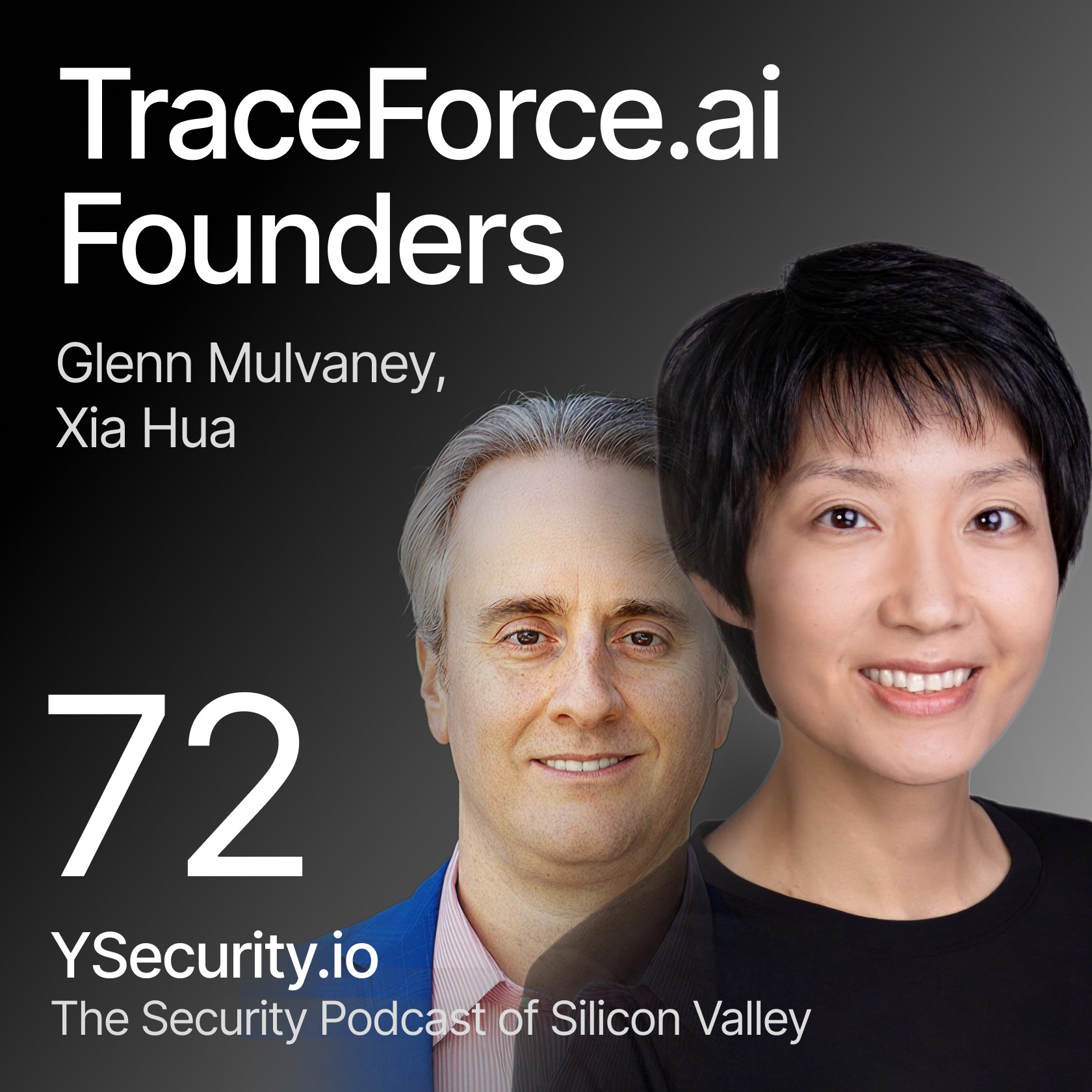
We have the co-founder, Shia, and Glenn. So Shia is the CEO and co-founder of Traceforce. Traceforce is actually an AI data security company that she started with her co-founder, Glenn, back in February 2025. Prior to Traceforce, Shia was the director of engineering at Clumio, which was yet another data protection startup.
They were actually acquired by CommonVault. What they do is they have industry-leading cybersecurity resilience products. Welcome to the show, guys. Yeah.
Thanks, John. Thanks, Sasha, for hosting us. We are super excited to be on your show to kind of tell you more about, you know, where we came from and what our visions are and where we hope to get. And of course, we are here to answer any questions that your audience might be interested in.
We got Glenn here, who has more than a decade of 20 years, actually, of experience in cybersecurity. So he and I are happy to answer any questions you guys have for us. And, Gun, in a past life, you were at Clumio as well? That's correct.
Yeah. It's great to be here, guys. Thanks. Thanks for making the time.
Since you guys met at Clumio and what inspired your entrepreneurial journey prior to Clumio, what happened at Clumio that prompted two of you to get together and start a new company? I've always wanted to start my own company, actually. So prior to Clumio, I was building in-memory databases at Oracle, where a lot of my friends joined Snowflake early on. I was building in-memory databases at Oracle, and they were building in-memory databases at Snowflake.
And the impact, you know, let's not talk about the money for a moment, right? The impact is totally different. More than 5, 000 people. I think Snowflake probably has 10, 000 customers now, right?
Whereas the in-memory databases that built at Oracle, I would be surprised if more than 2, 000 people actually used it, right? So coming from there, I always want to be part of an amazing startup with the goal of eventually, if I see a good opportunity, to start something on my own. So right after I had my second child, actually, I had two kids at Oracle to kind of enjoy, you know, my, you know, time a little bit with the family. And right after my second child was born, I talked to Poojan, who was CEO of Clumio at the time.
Poojan also came from Oracle, so I knew him, his network from Oracle, and I just decided to join Clumio. Then while I was at Clumio, I started again as IC, but I very quickly became their manager and then the director of engineering, managing pretty much all the flagship products there. I think it took me 15 years to get here, but I had always wanted this. I think every step of the way, it was sort of, you know, you kind of, I kind of had this goal, right?
I sort of know how to get there. I just, you know, I kind of took, took it one step at a time, right, to sort of get there. So, but, you know, I was given so much responsibility at Clumio. I knew I, you know, I was not going to leave Clumio just to start something, right?
I had to support my team. But, you know, the acquisition by Commvault was a great opportunity. Virtually two seconds after Woon, CTO, told me about the news, I said, Woon, I'm probably out of here. He's like, give me some time, give me some time.
So I give him a full month to hand off. And then February, I just, I just quit. Nice. So you always knew that you wanted to start a company and you are very well versed in the data, data access, because building databases, you unintentionally, constantly involved in questions around data access, data access controls, et cetera.
And having built that muscle at Oracle and then Clumio, you've, you've seen a lot of pain points that no one has addressed, or a lot of companies have tried, but failed. And you have this huge knowledge amount that you're ready to bring to the market and solve the pain point. And at Clumio, you guys met with Glenn. Right, right.
Clumio is where I met Glenn. Yeah, I think just having worked on databases and then worked on very highly scalable backup and restore pipeline at Clumio, I understand how, how to build a company from ground up from technical point for sure. And I also have kind of just slightly deeper understanding of the inner working of databases and, you know, the distributed systems. Yeah.
And at Clumio, I think one of the things that I knew I had to work on was the leadership skills. Literally, if I was not in office one day, people would not know what to do. Like 40 people, right? They were all extremely talented, but it's like in a symphony orchestra, you need somebody to string things together.
You know, I knew I had to learn, acquire that skill to be the CEO of a company. So I think in a way I prepared myself both from the technical standpoint and from the kind of the leadership standpoint while I was at Oracle and Clumio. Yeah. So you knew exactly where you want to be at some point in the near future.
You've had all of these technical skills. You knew exactly what needs to be built. And you've been part of the Clumio allowed you to gain that leadership skill. And it sounds like you have an amazing team at Clumio that was very productive, delivering amazing products that then later got acquired by a very successful company as well.
So the ingredients are all well aligned. And you've met Glenn, who is also very excited about security, cybersecurity and compliance space. And both of you joined into this amazing team to deliver a solution to a biggest pain point on the market. Yes.
And to me, yes, I think you're spot on, Sasha, right? Like how to build a company, I think I learned that muscle skills. But when? Opportunity.
That's the big question. Opportunities sometimes come half a decade, five years or a decade. Prior to this AI wave, what was the last big tech wave? Maybe Kubernetes, I think, right?
Kubernetes was what gave birth to Wiz, basically, right? Wiz was the CNAP thing, you know, the cloud workload and the Kubernetes. So every technological wave is an opportunity to build a great company on, right? And when that wave is on the rise, we got to catch it, right?
When you are over that peak, it gets hard, right? Like the peak would be like 2021 when Snowflake went public, right? Since then, how many SaaS, most SaaS companies' values have cut down in half, right? So I knew, right, I have to catch the wave, right?
And this Gen AI wave is like one of the biggest waves I've seen in my 15 years of career. That's where I see this is a great opportunity because when you're at the start of the wave, there are a lot of hard but solvable problems, interesting problem to be solved. So that's where I told Glenn, right, let's jump right in, you know, swim in the wave a little bit. Let the tide carry us.
Let the wave carry us, right? Because we want that tailwind. Yeah. So Glenn, you connected with Gia at this company you worked together with and how did you guys identify the opportunity, that wave?
The wave is coming and we know it's coming. What did you guys partner up to execute on? Yeah, that's a great question. Actually, we had pretty limited interaction at Clumio.
We were colleagues and we were on the same staff and in the same department, but I was always focused on security and compliance and Gia was developing product. And when we started discussing this after we had left Commvault, we looked at security and we looked at the AI wave and Gia would pose questions to me and say, like, what do you see as a big challenge in security because of AI? And that's really where we landed. Because like Gia said, the wave, the AI wave is different than others.
It just touches so many parts of our industry. It has so many diverse effects across what we do in tech. So, you know, looking further and further of what the adoption was looking like for AI and what security challenges were coming up, what were being addressed, which ones weren't being addressed. That's really where we focused in on data security and looked very deeply at what some of the struggles are for implementing AI.
Companies that are new and companies that are already established and what challenges everyone was having. So that's really the way that this started. And that's the way that we began our thinking and really the way Traceforce planted a seed. No, that's incredible.
And thank you so much for sharing too. And Gia, you mentioned that you came up through kind of like the IC rule. It sounds like strong technical foundations and then you developed a leadership style. And then before you know it, you were responsible for this huge team over at Clumio before Traceforce, almost like a proving ground or a testing ground or like a just a pressure cooker.
Maybe it's a good, good analogy sometimes, but it sounds like you have so many strengths that you bring to the table. And I'm, I'm super curious if you have maybe a superpower, like that very top one, like here's, here it is. And maybe a little story about where it came from. Yeah.
I think, I think Glenn might agree with me. I think of myself as a very focused person. And to me, it's all about execution. It's never about talking.
It's all about, you know, having a goal and then try to reach there. You know, when I'm able to find that goal, that purpose, I'm patient and I will get there. Right. It's like, you know, when I had this goal, I want to start something one day.
It took me 15 years to get there. You know, somehow I find a way, you know, I'm a fighter. So I think part of it is definitely personality. Part of it is also kind of learned through, you know, like earlier years when I was in school, I was the only girl and in a class of like 10, 20, you know, like elite kids trained for math and physics, Olympia, you know, solving really hard problems.
You know, there, I, I noticed there are like people who are more talented than me. Right. I knew in terms of talent, I have less. Right.
But you know, what am I going to do? Just surrender? No. Right.
If I'm in this, I have to find a way. Right. So I sort of kind of learned like an Olympia athlete, right? Like just not give up, find a way.
Talent is an interesting subject in itself. Talent can only take you thus far. It's being persistent and being consistent is what makes and brews a success. Just talent in itself is not enough.
As, as entrepreneurs, Glenn and Gia, what, what is your proudest day? I'm sure you've had a lot of excellent days that you'll remember forever, but what is the one day that you just, it's a highlight and you would like to share with us? I really feel like perhaps the day where, um, kind of, we sort of nailed our first customer, figured out that first product we want to build, right. After speaking with like two dozen design partners, right.
That, that was just like last month, right. We started in February. It took us some time, first of all, to even find these customers. Uh, there are two ingredients to start a, startup connections and the technical skills, the connection part people often overlook, but you know, just the technical skills, unless we're like building completely open source stuff, right.
But Glenn had the, you know, spent 20 years building connections with the CISOs, with executives at other companies that, that really helped us. And then like five of them were interested, but amazingly all of them want different things. Right. So we, but then we have a roadmap, right?
Like eventually we will get there, but what's the first thing we want to build, right. It took us some time to kind of iterate and think and prioritize. Ultimately we pick and chose based on how much pain it is and how much are you going to pay? Yeah, no, I mean, removing the noise of the market because market is very noisy.
Everyone wants something, but as a company, you cannot build all of it at the same time with the limited resources. And Glenn, it sounds like you are, you have that, you have that experience in the space, you know, you know, people, you know, all of these different pain points, but focus is what needed, especially early on. You just want one single pain point that multiple partners are looking to purchase. And then there's also a question of what's the, how big of a pain point that is and how much dollar amount signs is behind that pain point.
Yes. How big is the market basically? Right. Yeah.
Glenn, what about you? What's the, what's the proudest day? Yeah. So, I mean, related to what she had said is being able to talk to CISOs, security leaders and other places that are, that have been in my role and having them express those pain points, understanding them and then saying something like, wait a minute.
Okay. I see this. I think we can help you here. Like this, what if we did this?
What if we did that? And then getting that engagement from them and just kind of feeling that, that empathy with them and feeling the relief that, okay, like they see a path forward here. Like I've got this painful pain point that's being caused by something in my org that I have to deal with. And you guys know, as security practitioners, there are just myriad pain points.
They're legion, right? They're everywhere. And it's what is the hottest and most difficult thing at the moment? So just get, just being able to help somebody who is in my role in another org and really make their life materially better, improve things in their org and improve security for their org.
That's, I think that makes me really intrinsically very happy and very proud. So how about, how about the converse of that question? What's been the most challenging day on your entrepreneurial journey so far? I think the, the initial conversations, uh, with the first set of investors were definitely, um, the most say challenging, but you know, yeah, most difficult, um, cause we didn't know what to expect, right?
Sometimes, uh, you know, investors say no in, you know, very subtle way, right? It was definitely took, took us some learning to be able to, you know, handle rejection. Sometimes actually the initial conversations really helped us iterate on product, really helpful. Um, these were super friendly investors actually.
Um, and, and then, um, the later stage when our product got a lot better, it was more, more or less because perhaps they have a competing portfolio company already. Right. So then we understand, right. Um, we, we have to show more progress and stuff.
Overall, it's, um, much harder than getting a 4. 0 GPA at MIT. I can tell you that. Is it because there are a lot more variables?
Yeah, because humans are unpredictable, right? Math problems, you do what you need to do, always solved, right? Humans, you know, unpredictable. Humans, we're something else.
Like we're not a math equation. Don't, don't tell that to all of the hardcore AI folks, but, uh. And yeah, and, um, unfortunately starting a company, as I was telling you, right? Technical is just less than half of it.
In the early days of a company, you would think that, oh, it's all about building. No, it's all about customers. Sell before you buy, right? So then, you know, Glenn and I have to learn like new set of skills, right?
So it was overall very challenging. We both had to get out of the comfort zone. I gave Glenn a really hard time. I said, you got to sell.
He's like, I never sold anything before. I was like, you know, all these CISO friends, sell it to them. Really? Like I always assumed that like Glenn, you had so much like a foundation in that space.
Like you're a natural at it. So connecting, connecting with people. That's what everybody thinks, right? Yeah.
I'm, uh, yeah. I'm, I'm, I'm pleased to hear that. I, I feel again, you know, my, my, I always think of myself still as a, as a practitioner. And when you're a co-founder, it's, you can't think that way, right?
You got to think differently. Um, because so many different things are required on that, that journey, uh, you know, as a, somebody who had been always adjacent to the BC community, being close with other co-founders, hearing their journeys. And, uh, you know, I think of myself as a pretty level-headed person and I sort of thought, oh, this is the way our fundraising journey will go. And I was very, very wrong.
And, uh, it's a learning experience. And, uh, you know, she had talked about some of the, some of the interesting, uh, the days that we had and feedback that we had, but like when I, what I said before with conversations with folks like yourself and other CISOs, there was never a wasted conversation. We always learned something. And everyone that we've talked to in the investor community was helpful really like, and, and it's, it's incredibly gratifying to have those conversations with folks like that and have them give you, sometimes the feedback's muted and sometimes it's direct, but it's never wasted.
Is there a person or an event that was most impactful in this journey, in the journey of life, in the journey of entrepreneurship? Oh yeah. Do you have a mentor or a guide or someone that you've looked up to or helped you guys grow or? Um, I mean, for me, I mean, uh, in this fundraising, I think, uh, our advisors were just in, you know, this past, uh, few months, I think, uh, our advisors have been amazing, you know, whether it's Poojan and whether it's Kamal and Wei, they are all very successful entrepreneurs who have sold companies to public companies before.
Right. So we definitely learned how they view the market and what they see, uh, as a, um, you know, can, can lead to a successful, you know, product in the long run. So these folks are definitely, uh, very, very helpful. Uh, Glenn, do you want to add anything?
Yeah, I, I, I very strongly agree with, uh, uh, the fact that our advisors have, they keep you grounded and their expertise is, it's just indelible every conversation we have with them. But from, from a mentorship standpoint, I, it's hard for me to single somebody out. I've been really lucky to meet a lot of just absolutely tremendous people, um, throughout my career in Silicon Valley. If I had to make a list, I would have to like, we'd be here all night.
I mean, it would be, it would be like, I'd be getting played off the stage at the Oscars. Um, but, uh, I really have to thank a lot of my, my colleagues and managers through the years and, you know, your colleagues, your IC colleagues from 20 years ago are in leadership now and C-level positions. And it's just, it's been just such a fantastic journey. And without the, the mentorship and the, the, the folks that have helped me along the way, I can, I can never thank them.
But whenever I do chat with them, I try. What do you think is the biggest opportunity and biggest pain point in the security space that is, is about to arrive and will be very pronounced in the next five years? Yeah. So when we were start thinking the picking direction, right, we kind of surveyed all the existing companies and seeing where kind of the opportunities are.
So today really only two types of companies are getting funded in the security space. One is AI stock agents, AI security, basically because security professionals like Glenn always complain to me, like they're drowning, you know, signals and the noise, right? They, humans aren't so good at, you know, kind of going through all these signals and trying to figure out, right? Like it's, it's very repetitive, very era pro.
This is definitely a great opportunity for AI agents to really help us. Right. And the other type of companies is security for AI, right? It's a little bit like a security for Kubernetes, security for the cloud, right?
When you have a new technology there that you have a new surface of attack. Now you have to cover that. Right. So I think both are very, very hot areas right now.
And I think this is proven by the fact that I didn't know that when I started a company in February, but just last month, right, several companies came out of stealth with like 20 million seed, 30 million seed, 50 million series A in the security for AI space, right? It's yet to tell if there's any, you know, real substance in, you know, in this, but I definitely see that we know there are solved problems and, you know, a lot can be done. Yeah. Coming from a developer space myself, it's more natural for me to want to attack problems in, you know, building a new agent applications.
And I definitely see this as a very different opportunity, very different shift left paradigm. Used to be the security is, you know, like very much to the right, right? But like starting from sneak and all that kind of company, especially the AI company now, it security has to be built in the product since day one, right? So there is a whole breed of company just focusing on that part, actually, right?
Integration, how to enable agents to, to, to perform within their permission boundary. So that's actually a very interesting point because security is very complex and very difficult. When you try to add a security control to existing product, it can be quite tedious and you might miss certain things unless you are extremely well-versed in that product and the security control that you're trying to add. What we're trying to see and what people start to talk more and more about is how do you make security seamless?
How do you make security such that there is no room for human error when you do either integration or the implementation of certain controls? And the bottom line is security needs to be part of the product from early stages in order for it to be effective. Yes. Yes.
Yeah. It's a, it's a, it's a very hot topic right now, especially with all the MCP stuff, right? The MCP is going to, you know, be the next HTTP, right? And this security.
. . It will be MCPS. Uh-huh.
Yes. Yes. MCPS. Yes.
So, so, so is it, would it be wrong to think about trace force as maybe like a potential like MCP firewall? Actually, yeah. Yeah. We, that's definitely one of the things that, the directions we could go into actually.
Yeah. Yeah. I think, I mean, for the challenges coming in the next five years, for sure, I see it as two problems and they've been around for a while monitoring or you want to call it observability and also prevention, right? And because of the aforementioned, you know, ubiquity of AI and how it's accelerating everything.
Um, you know, Sasha, you mentioned how security is complex and this is really pushing and putting a lot of pressure on security because it's a whole new set of challenges that are built on an already well-known set of issues, right? It's, uh, that in many ways AI is, is just bringing some of our well-known security issues to the forefront through a different means, right? Um, lack of good, strong identity governance, lack of a good data security posture, right? Maybe these were siloed before, but now AI applications, AI agents can change that.
I was really encouraged to see the very strong renewed push at RSA and at B-Sides, uh, to really do the shift left development and discipline security discipline from, from day one in the development pursuit of SDLC. And I'm really encouraged by that. It just doesn't happen overnight. It takes a long time and it's, and it's a shift for many software development organizations because of the way that our industry has worked right.
I mean, software development hasn't always prioritized security as part of what is being built. Um, so at the same time, we also need better security tools. We need tools that are more sophisticated, that will give deep observability. And more importantly, the hardest part is prevention, right?
Once the horse has left the barn, it's great that we can do the forensics. It's great that we can figure out what happened and learn how to close those gaps, but really prevention to me is the key. And that's really where trace force is focusing. We're not ignoring monitoring observability, but we really want to deliver something for prevention.
I think the economics are structured in a way where prevention is so much more efficient than chasing down, like all of the bad things that could possibly happen that are happening right now, that are going to happen in the future. So I, I, I see that there's a lot of like efficiency that could be had if we just take a little bit of prevention, just, I agree strongly with that. Yeah. I agree strongly with that.
I don't want to stop doing threat modeling and risk analysis. We, that's the basis of how we really make effective security controls, but you're right, boy, the prevention stuff certainly goes a long, long way. So perhaps this massive adoption of AI technology, and we will not go into details of what, what's behind AI technology. It's the podcast in itself, but it feels that AI adoption is a blessing for existing security control issues and accelerator to solve them.
Because if we don't, then it's a, it's an exponential growth of threat attacks that will, will start occurring. Exactly. It supercharges both sides of the, of the issue. I agree.
You know, I was on an interesting security call. It was a security review. And I know a lot of times it's, it, it's very efficient to think about security as focused on data. And for the very first time in a very long time, the shift moved off of the data and onto what agents could actually do and execute.
And it was just so refreshing because, you know, a lot of security folks do focus on data, think about data, how do you protect the data? If there's a breach, it must be about the data. But, you know, in this world of agents where these things can actually perform operations, there's a whole bucket of like ops and actions and a new world, I think is just like right around the corner of how to think about Spratt models and how to protect systems. Yeah, exactly.
Like we need like a kind of a, almost like a parallel agent, security agent to monitor and to prevent the, you know, the, the core product agent from doing things beyond its permission boundaries. Like in the past, we had DLP solutions, the old classical DLP solutions that would essentially build some type of guardrails to ensure that a person cannot extract information and pass it somewhere else. And their entire company is built around that. With agents, now you have this field with infinite number of functions, agents that can pass information to each other.
And how do you control and trace through the lineage of that data flow? Yes. It's a very interesting question. That's exactly the problem that prompted us to start Traceforth.
And then we are, you know, thinking about it every day, um, keeps up peace, keeps us awake at night. And yeah, definitely think you guys said it really well. No, no, I'm, I'm so grateful that there are such incredibly smart, dedicated and focused people taking the opportunity to think through these really challenging problems that everyone in the security community faces. Like, let's be, let's be honest.
Like everyone faces this. Yeah. We can, we can delay it by saying no to all of these new technologies and all of these new vendors, but eventually like we're like, that's exactly what enterprises are doing. Right.
If they're not sure, I'm not going to use the Salesforce agent. I'm not going to use the Workday agent. Right. But, but then people who are late to adopt these technologies, they will be behind other companies will fall behind.
And eventually those CEOs that run those companies are going to have to step in and be like, you know what, we have to figure out a way to make this work. Let's get into our ecosystem. We need to adopt this. Like I can't fall behind anymore.
Exactly. Yeah. That's where the mark, the opportunity market opportunities are. Right.
So I guess everyone gets to decide like what sort of adopter they want to be. You want to be an early adopter, be a late adopter, like catch up, you know? Yeah. But then fortunately being late adopter in the age of AI is likely too late.
Death blow, maybe. Yeah. Things moving so fast. 10 years ago, we could plan a year ahead and we could say, this is what a year from now things will look like in the field.
Now, maybe three to six months. At most. At most. Yeah.
All these startups that started building API integrations, they are all now had to pivot to rewrite their stuff because of the MCP. So that's how quickly things change. Yeah. The analogy I would use is like everything is like on your old time EVCR.
Everything is running at 2x speed now or 4x speed. It's actually hard to tell because it's not playing in real time anymore. Those decisions that you mentioned, Sasha, that like, yeah, maybe we had a 12 month window to plan now. It's down to like three or less.
Like people have to make these extremely business critical decisions right away that affect massive efficiencies. So yeah, I feel like everything is just in fast forward right now. Anyway, let's fast forward into the future. If you guys use your, your supervision and your, your founders, like, like creativity and imagination, and you peer into that future, and you see Traceforce is just an amazing success, hundred billion dollar company, knocking it out of the park.
What does that look like specifically? Like what does success look like for, for you and, and for Traceforce? Traceforce will be the Palo Alto network of agentic applications. You know, when you think of network, you, you, you associate with Palo Alto network.
So all the agentic applications, I want people to associate with Traceforce, who can trace every agentic action down for you and automatically prevent it, bad things from happening. The name is excellent. It's, it's, it's, it's really well descriptive of the functions that will execute the vision that you guys have. Thank you.
Love it. I love it. I'm excited. I'm so grateful that you guys are thinking through this problem.
It's gonna, it's, there's a huge wave coming. I don't think people quite understand how big a wave this really is. And it's just, it's just the beginning. Um, we haven't even started to see adoption yet.
Let's go in the other direction. If we could go back in time, you could meet your younger self, would you? And what would you, would you have any advice for your younger self? Or would you have anything to share?
Work harder. I didn't work that hard when I was younger. It doesn't sound like that. It sounds like you're, you're an amazingly hard worker.
But maybe the younger she has a different. . . Um, there are people who are like, uh, you know, like, let me like, maybe like folks like Michael Jordan, who always knew he only wanted to play basketball.
Right. So he, he was very focused in, you know, since the beginning of his life. Uh, but, uh, not everybody is lucky like that. Right.
Like I myself had wondered about many different directions. I started, I, I was even thinking about going to academia, uh, you know, math. And part of it was because I was influenced by my, my father as well, who was professor. Right.
Um, so I think, uh, I w I wish it was a little bit sooner for me to, to be able to figure out what I wanted to do. Um, and that's what I always teach. Thank you. Thank you for sharing.
Thank you for sharing. Yeah. That's what I teach my kids. Right.
Like, um, that's why I moved from, uh, China and Hong Kong to the U S because it's a great country where people really get their opportunities. Right. And I wanted to give my kids the opportunity to kind of follow their heart, figure out what they want to do as early as they can in their life and really, um, make an impact. Right.
Don't just work for salaries if possible. Right. Do something more. That's an excellent point.
There's so many unresolved opportunities out there, whether it's software, hardware, or just life, but we, we need people that are passionate and ready to solve them. And just to expand on that a little bit more in software and in security space specifically, there are so many unresolved pinpoints that we necessarily may not be able to solve right away. If you could wish for someone to solve one of the pinpoints that you guys not working on, what that pinpoint would be.
My number one pain was just signal to noise in, in any security tooling and in your sock, when you're unifying all of these things with all of this monitoring and observability, how do you focus on what's important because you just have so much telemetry coming in and there's been so many efforts at trying to do this and companies like profit that are applying AI to this have, they have the correct model. I was, I was lucky to see a very early demo of profit and I was really impressed by what it could do because I already had tools that would do correlation and do deduplication and, you know, really try to get the signal to noise down.
But the effectiveness is always limited by the scale of what you're trying to process and profits the first time where I've seen something a little different and I really, really liked what they did and I really saw the effectiveness and there are a lot of players in that space, but that they were outstanding to me. Oh, I'll have to check that out. Sounds like a great platform. I haven't sunk my teeth into any one in particular yet.
And it sounds like you've got the inside connection. Yeah. Yeah. I mean, we mentioned Kamal before and he is on full disclosure.
He's one of our advisors. But we had, we had seen profit before that. I mean, actually we were still at Climio and this was long before Traceforce was even a, even a twinkle in our eyes. So, but yeah, I mean the SOC, I think everybody's seen it.
And I think if you talk to most practitioners and security leaders that figuring out a way to make SOC's more efficient is really key. And it's been a problem that's been around for a long time. The more we have to monitor, the more sharp that problem becomes. Definitely.
Definitely. Well, it's going to be an incredible journey. So much is changing. I'm so grateful that we have incredible founders building amazing companies to solve all of these difficult problems.
I don't think any one person is going to solve everything, but I'm so grateful that you've found something to sink your teeth into and serve, you know, get back to the security community, um, actually improve the lives of human beings behind all of this technology. Yeah. So thank, thank you so much for coming on and sharing a little piece of your journey. Uh, Shia, it sounds like you're just an incredible human being and incredible mother, um, as well.
Thank you for sharing like that very vulnerable piece, uh, with all of us and Glenn, just awesome. So grounded, so much empathy. I feel the warmth. I'm excited.
Uh, I'm not even part of Trace Force and I'm excited for Trace Force. Thank you so much guys for having us. This was fantastic. Thank you, John.
Thank you, Sasha. And always thank you, Glenn. Yeah. I really enjoyed every minute of this show.
Um, first time on podcast, by the way, it's my first time and. . . Well, welcome.
We have to have you back. We'll, we'll do like a year, a year check-in. Thank you so much for your time. Thank you also to all of our listeners for tuning in to another episode of the security podcast of Silicon Valley.
I'm your host, John McLaughlin, one of the hosts, John McLaughlin, and I'm joining the other host, Sasha Sinkovich. And this is a Y security production. Thank you, everyone.

This episode covered SOC 2.
YSecurity helps teams get audit-ready without slowing the roadmap, from first scoping call to clean opinion.
Talk to YSecurity