55. Haseeb Awan, Founder and CEO of Efani, Revolutionizing Mobile Security for the Digital Age
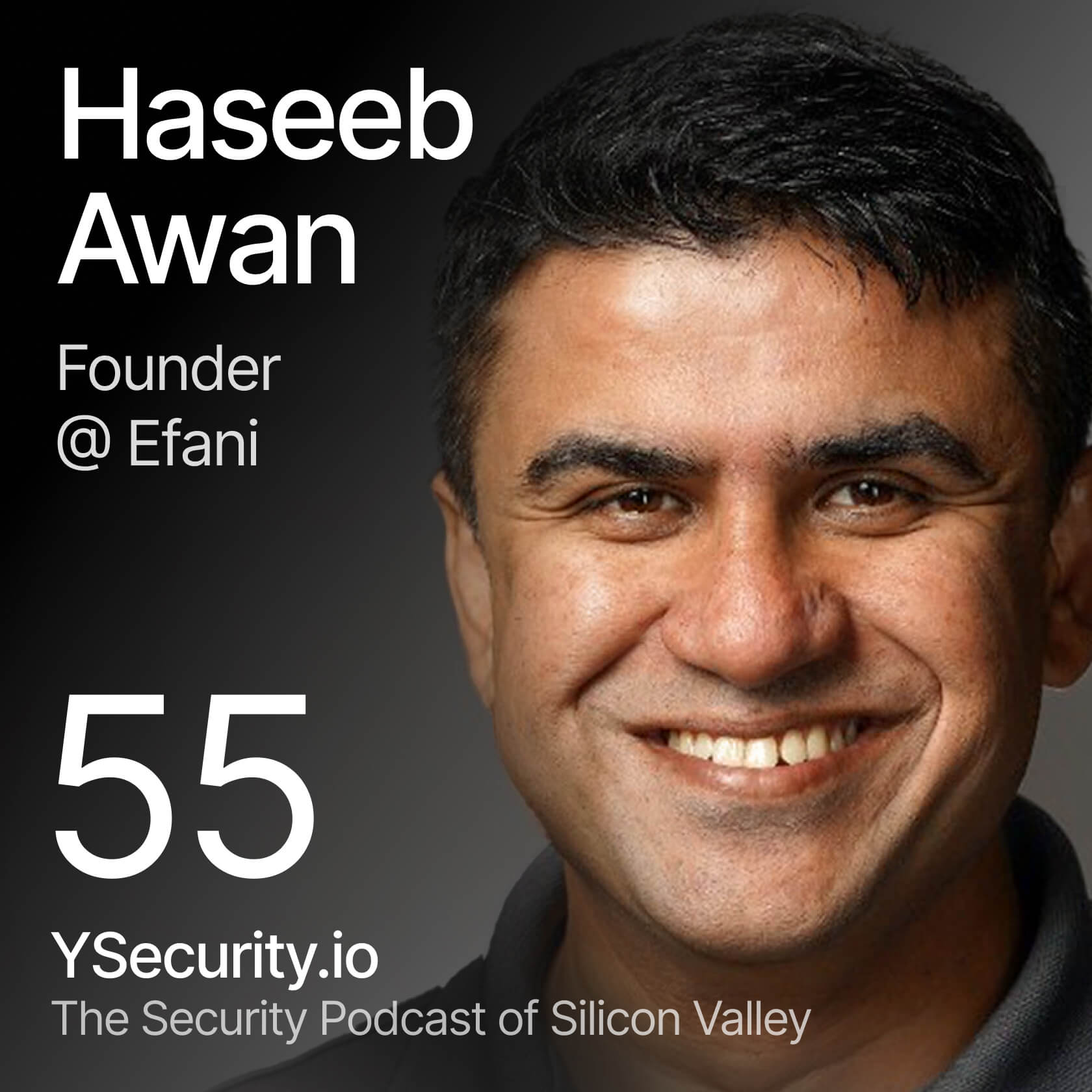
Hello, everyone, and welcome to another episode of the Security Podcast in Silicon Valley. I'm here today with a very respectful guest, a founder and CEO. His name is Asib Awan, and he is the founder and CEO of Afani Air Mobile. Welcome to the show.
Thanks, John, for having been on the show. Ah, it's my pleasure. Bring a lot of great experience to the table. And just glancing at your LinkedIn, you've been a founder of something or another your entire life and your current startup.
You've been focused on it for almost five years now, where you're trying a bulletproof mobile plan at Afani. Previously, before Afani, it looks like you were a co-founder of BitAx, Inc. So what did you do at BitAx? I co-founded it.
So I was responsible for fundraising most of the time, business development and media, mostly PR, and making sure people buy our product, people give us money to build our company, and make sure people talk about this. How did you change the world in that way? I don't think with that money. Well, we have a funny party that was talking about the story on 4th July that on 1st July, our company, we got acquired last year by SPAC.
At the time of acquisition, we had 10, 000 locations of Bitcoin ATM. We started from almost zero, obviously zero and now 10, 000 locations. On 1st July, I think 3rd July or 2nd July, it went public, it's going to be 3rd July. And so I shared a story on 4th July that this is American dream.
We started a company. I came to US kind of without a visa, like not a proper, like a work visa. And we basically started a company, moved back to Canada. And just before 4th of July, our company went public, right?
This is the American dream. People talk about negativity or America. I am the example of American dream. And so a lot of stuff that you mentioned, they were national progression for me.
It's not like I was thinking, I was planning that, hey, I started this company, I started this company. Frankly, with Bitcoin ATM, we just want to buy Bitcoin for ATM for ourselves, Bitcoin for ourselves. We were struggling in our startups. So we said we need a system for people who can buy Bitcoin.
So we were in a good industry at the right time. And frankly, we didn't do a lot of things. Like it was always a push, like it's AI, right? Then nowadays you talk about anything about AI, people want to invest in you.
People want to hear you out what you're doing. If you say, hey, I'm building a new social network, like maybe yes, but if you say, hey, I'm building a new, like timing is very critical in the industry. Like you want to- The market. Yeah.
If the market is ready for what you're about to do. It's huge. Right. Yeah.
Like today, if you say, hey, I'm launching a layer one, it's very hard to, or I'm launching NFT today. People will not listen to you. Yeah. Like they'll listen to you if you're launching an ICU.
Yeah. And I, or if you talk about AI, you have their attention, so to speak. Yeah. I feel like security is still a pretty hot topic.
Yeah. Not certain. I'm sure it is. Right.
I think that cybersecurity, like cyber attacks are not going anywhere. They're increasing. So even for us, we are an industry where the demand is growing up. If you're an industry where demand is automatically growing, you don't have to do a lot of things.
You just have to serve the customers. So I'll give you an example there. If you're into where people like COVID, I'm just making up people who want to national and medical, anything related to that, they didn't have to do anything. They just had to produce stuff.
With Bitcoin ATM, we didn't have to do a lot of stuff. People just wanted more and more Bitcoin ATMs. So we just kept on producing it. So in today's industry.
A one to end problem, like fairly quickly. Correct. So in our current business, we don't have to do a lot of marketing. Like people are hacked.
So they come. They say, what's the more secure cell phone service? They come to us and that's how we grow. And now you're talking about Afani.
Afani, correct. So I would hack myself. Like I was hacked four times. I was looking for a solution.
And I figured out there's no cell phone service for rich people. Let's put it this way. Like if Bill Gates wanted to buy a cell phone service, he has to go to the same Verizon store. If a person on the street wanted to go to the store, he would go to the same Verizon store.
While they have the same option of having their flight chartered, they go into stores where no one is there. They do everything. But when cell phone service comes in, they all have the same plan. And they go to Verizon, they have to call 6-6-1-1.
And we're doing line for half an hour. The assistant is good for them. But there's no cell phone service where they're business class or first class for cell phone. Except we built a cell phone service for rich people.
So when you mentioned that you got hacked, your phone got hacked. Like what happened? What were those? Were they SIM jackings or?
Yeah, SIM jacking. So people call it port attack, SIM swap, SIM jacking. The multiple names, the problem is the same. The problem is that someone gets access to your telephone number without your consent.
So one day you will wake up or you're just camping or doing whatever. And you do signals. And you may say, okay, it's okay. Maybe it's just a network issue or something.
But literally you start getting email that, hey, your password was changed. Or please do this verification or something. And you can't log into an email. And then, okay, someone has taken over your telephone account because a telephone account is my identity.
Today, everyone can actually take care of my. . . So anyway, that's what happens all the time.
And people get hacked. They bribe people in the store or do social engineering. And they take care of their telephone number for half an hour, an hour. And what hacker does is he uses their telephone number to get an account.
Because your email is linked to your telephone number. Your bank account is linked to your telephone numbers. And within like maybe an hour or so, they take away all your money. They explain your finance.
And then they go into their email, take away all the information, go into social media, ask money from your friend. And within a couple of hours, pretty much you lost your social, financial, and potential capital. Yeah. That can be really devastating, especially if you've worked so hard to build up some of those positions and some of that reputation.
What's the story of how you got into security? You were just a victim of being hacked? Yeah, yeah. So sim-stopping is something that's very common.
People from janitors to like CEOs of the company get hacked all the time. It's happening as you speak. So right now, when you're talking to someone is getting things up right now, which means the next half an hour, he'll lose pretty much everything he has. And he will call Verizon, AT&T, or Chase Bank, whoever they're dealing with.
And they'll say, sorry for the inconvenience. Let me work on it. And he'll spend the next 40, 24, 48 hours speaking to everyone, draining his own life. And what he will discover is that he will get a letter in mail or apology that, hey, John, I'm so sorry you lost your entire money.
Here too, we can't do anything. And again, I'm talking to right now, between now and probably the episode get deleted, thousands of people have lost this way because they were on a family plan or they were using a common plan. So again, as we are talking between you and me, there's a criminal who is actually hacking someone's account and trading all the money. Right.
You're right. Our phone is a major part of our online identity. And if you can steal someone's phone number, you basically have access to their additional footprint, their digital identity. You can reset accounts.
You can reset passwords. You can lock the other person out of their phone and essentially their online life, which unfortunately is connected to our financial well-being, our reputation, as you mentioned. So how does, so what's the approach? So if someone comes to your company, a secure mobile and says, okay, let's, I want one of these plans that's like secure and helps me like protect, protects me against all of this stuff.
How does it, how do you pull that off? So we are simple. Yeah. In the US, there are a lot of MVNOs.
You go to Walmart, you go to any store, Best Buy, you see multiple companies, different brand names. So basically we are all MVNOs, mobile virtual networks. So example is that everyone is like Dropbox is hosting on AWS. Now Box.
com, they're like dozens of cell phone hosting solutions that are built on top of AWS. Right. So just an analogy of how it works. What we do, we go to Big Carrier and we say, give us a thousand SIM card, give us like a terrible data.
And we will basically start our own company. So you can start like, hey, John secure mobile tomorrow or John mobile. Right. And you say, hey, I target on people who want to do this, who go to college.
Right. Or so people pick up their demographics and they start focus. Someone will be like Latino based. Someone will be like, I focus on Chinese.
Someone will be like a faith based. So everyone has their own focus. Someone like mostly they're focused on lower end because top companies do not want those customers in their stores. They don't want to deal with someone who doesn't have a credit card or doesn't want to buy expensive plans.
So that's what their normal target audience is. Okay. So what happened was that I went to the same company and said, okay, we will give us the minutes, but we control the port out, which means that no one can make changes to the account unless they go through a process. And the process that we set up was because I'm dealing Bitcoin ATMs.
We have pretty much gone through every possible theft attempt that you can think about. Your ATM machines were like subject to all sorts of batter and assault and rape and you name it. It probably happened. You think about it, right?
Just to give you an example, we last year, because it's public information now, we transferred, the company went public. So we transferred $1 billion in cash, around 10, 000 locations. Right. Wow.
So one, so think about it, $1 billion. Okay. That's a lot of money. Right.
So when you transfer the money, you come across people who will come in trucks and with machine guns and hand-waring that they'll steal money. We are people who will just literally storm your apartment with steal money. There are people who will sit down and settle. So you think about hacks that they've spent money and they would have done it.
So I realized that, okay, man, what are the weaknesses in the system? How do you protect? So like in our company, we make sure that no one knows our employee location. They have limited kind of access.
Because I literally know that I can be hacked. I can be kidnapped. So my addresses online are also like, I be a very private person in terms of where I live, what I do. And so long to be short, we start implementing the same solution.
Now, obviously, telecom doesn't go that far because it's super easy to hack people account anyways. So as per Preston report, 80% of people get simps up if someone attempts them to do so. So if someone comes after you, there's an 80% chance they'll be successful. So they don't need to go into our system.
So we said we will make it so difficult that an average hacker cannot come off our clients. That's what we did. And we made it so difficult that internally, it's very difficult to make any changes too. Which means that we only can offer one or two plans.
So we only have two plans, early and monthly. There are no other product that we offer. We don't give you Netflix. We don't give you Hulu.
We don't give you, hey, you have this thing. We just say that we give you security. That's it. And it's frankly a pain to change anything on our system.
And it's frustrating sometimes that, hey, sometimes you have to get permission. And, but we said it's okay. We are not in a business of convenience. We are a business of security.
And with security, you have a lot of inconveniences. By blood class, you can't open your windows. If you have, you can't walk into a store normally. It's the cost of being famous, the cost of being more secure.
It's the price to pay. Yep. It's the price of privilege, right? Everyone has their own thing.
So we just say, and in order to have that, we just say, hey, man, it's expensive. Why is it expensive? Because you live in a shared, think about it. If you live in a shared apartment, your cost is low.
But if you want to have your own ranch, your cost will be higher. That's right. Hey, you're going to get a little bit better security if you're not sharing that space. So what's it?
I mean, for you personally, as the founder and CEO, and you've been at this four to five years now, four and a half years or so, what's your typical day look like for you? I typically enjoy a lot with the, I hate operations, but I love product work. I love working on the product. If you ask me what you do, it's obviously what I'm doing right now.
Something that I do every couple of days. I talk to media. I talk to professionals. A lot of my work is also revolved on talking to extremely important people, which is the most interesting part because I don't watch TV a lot of time or I don't watch any sports.
So a lot of time I come across people that are super famous, but I literally have no idea who they are. So that's the most funniest part of my job is that they probably would have 20, 30, 40 million followers and I have no clue who they are. And it makes a very awkward conversations too, because they believe that the world knows them. And then they meet across someone who lives in the US and have no idea what their song.
Or what team they play for. Right. So we have a lot of NBA teams and I don't watch it. I think I've watched only one basketball game in my entire life.
So when I was onboarding their team, I was talking to them and then people say, oh, oh, you met with him? I said, yeah, I met with them. And for me, that's just a nice, another human being from your perspective, which is correct. And it's not like, I don't like, I literally don't know.
Right. So that's the most funniest part of my job sometimes. And what I focus on is I'm always scared of being hacked. That's my number one fear that basically, because we have not been hacked yet.
And I say this to all security and I'll take that. Frankly, we are only good till we are not hacked. Our entire business, our entire life depends on not being hacked. So think about it.
If you're a goalkeeper or a defender in soccer or any sport, you don't know who's coming and where the ball is coming from. You literally have to secure, make sure that every goal is secured. And if you, and if one goal goes through, your entire career is done. Well, it's going to be a challenging moment if the goal goes through for sure.
It is. But this is what I think. Think about it. Right.
We are people who can be a state level actors. We can people who are ordinary criminals. We can people who works against us and they're working right now and I'm talking to you. While I'm sleeping, they're still working to hack our clients.
And obviously it's a very tough job because it's like being, people say that being good to people is like a goalkeeper, right? You only are remembered for the goal you missed most of the time. So in a hack thing, there are thousands of cybersecurity companies that you only know about them till they get hacked. Before that, we don't even hear about them.
So as CEO, I think that's my number one fear or that's my biggest vulnerability is that I share that when is going to the, when is that moment? So if any of your customers get hacked, it's actually you that get hacked and you're going to take that reputational damage. Correct. Instead of the customer, right?
Well, in addition, I suppose, to the customer because the customer. No, but customer is insured, right? So all the customers are insured for five minutes. Oh, okay.
So that's part of the package? That's part of the package. Yeah. Nice.
So if you are T-Mobile, you get an apology. Hey, you lost money. I'm so sorry. In our case, you get money.
So you say, hey, I lost $100, 000. Well, that's an attractive feature. $100, 000. That's very creative.
Yeah. Because you never know, right? You just, you just never know. And cybersecurity insurance is a very real thing.
And it's a great way to help cover the unknown unknowns and the gaps in there. But you must have some good help with you. So how many people are there in your company today? Just over a dozen now.
Just over a dozen. Okay. Yeah. And I bet you bring on board, like you mentioned, like maybe ops is not your passion.
So I bet you have some really competent and passionate ops folks to help execute on your vision. But you also must bring in security folks too. Well, things are always breaking too, to be honest. I won't say we run the best operations.
There's something else breaking, right? As a founder, I'll be lying if I believe that everything is perfect. No, it's not perfect. We try to do our job.
There's a lot of things that need improvement, right? Like our things are not scaled. So sometimes for the last two months, we are growing rapidly and we are unable to scale as we want it to be. So we had to shut down our system multiple times.
So we can't take any more orders. So that's something that is lacking in our end. We are now looking into improving our engineering. And we made our engineering team just two days ago, operation team.
But basically our engineering team is not called engineering team anymore. It's called operations team now. And we realized that what if we turn our engineers into operators, like operators operating the system so they can build solutions so we can improve our operations. Whoever feels the pain is going to be able to fix the pain.
You're right. So if an engineer is working on helping a client, okay, I can just write a couple of lines of code and then automate this process. It's okay. Why don't everyone become their operation tomorrow?
So literally we got rid of our engineering yesterday, like two days ago, actually. And now we only have marketing, like obviously activation team and then general marketing team. So everyone got promoted to ops. Everyone in engineering got promoted to ops.
I don't know if I'm emotional or pro, but everyone is ops now. I was just going to go promotion because that's like a great honor to be directly. I know, but everyone is operator now. Okay.
Everyone is at operation now. Nice. Nice. Okay.
So what's the best day that you've had so far in your journey as an entrepreneur in this secure mobile space? I think the first one was when we got our first paid customer. And how long ago was that? How long ago was that?
So we started three years ago and it was like just a month in. Wow. It only took a month. Wow.
Yeah. Incredibly fast. Yeah. So I was customer number one, but first paid customer.
So I made a call from my line to his line. And I said, okay, both the people who are talking to my line. So that was like something that we make because both people are on your line. This is the most secure cell phone service you can have in the US.
We created it. So that was the most thing. Probably second one when we crop $100, 000 ARR, when we did $100, 000 ARR, and when we turned profitable. So there are a lot of interesting moments, right?
And I think the biggest moment that we have seen so far is that we have a retention of 90 and 99%, which means that a customer signs up, they stay with us. 90 and 99% of customers stay with us. So to summarize, I think finding first customer and getting to $100, 000 ARR was something that I looked at the number and I was like, oh my, this shit is. Nice.
Okay. How about the most challenging day that you've ever had in your journey at Afani? A couple of times. First thing is whenever you update a customer, suppose I am onboarding John, right?
And it happens from time to time too, where a customer said, I want to switch to Afani. And for some reason, the activation takes time. So they are out of their cell phone for half an hour, or they sometimes screw up and they are out of service for one day. It really happened.
But whenever that happens, even if it happened today, I'll be panic mode, right? Because people like to depend on that. And that is always something stressful for me because I am always in, I wouldn't say panic, but I'm always thinking about, hey, this person is without a cell phone service right now. And what if he needs cell phone for his work, for his medical emergency?
Like sometimes people are old and they need, they are alone. Yes. What if I don't have a way to reach out to them? And they don't have a way to reach out to me too.
So I can't even help them out. So that's always challenging for me. And that is something that happened like maybe four or five times, but every time it happens, it stresses me the most. It's very hard for me to sleep that night.
It sounds like you care deeply about your customers and your customers' wellbeing. So possibly because I went through a trauma. So this is personal to me. I, for 18 months, I wasn't able to function properly because I felt that I was very smart in securing myself.
As in, I would use hardware keys, I will have a separate laptop, use fingerprints like firewalls. You think about a security product that is needed and I'll have it to install myself. And no one was able to hack me in crypto. Think about you're processing so much money and you no one had.
Even today, it's almost impossible to find my real address. Even today, because I was so paranoid that I lived in an Airbnb for a couple of years. Wow. No car under my name.
And basically because I was that paranoid about other stuff. And you would not find a picture of my family across the internet because I don't use social media. Like I basically was like, not like Facebook's where I'm traveling and everything. It was on the purpose because we were in a very high respect.
So I realized that when my number was hacked, that was one. And I realized that my entire castle that I built, basically there's no foundation to that. Because someone can literally go into a store, steal my number, and I can't do anything. So I have an MDN, I have a new iPhone, I have set up firewalls.
All of the things, all of the secure enclaves and everything. It's just pretty much gone, right? You're violated. And people say that, oh, I did the steal my number.
Sorry? You feel violated. I'm still violated. And I tell you about this thing, right?
Because a lot of people have trauma. And this is something personal. And a lot of people may not agree to that. And I always think, okay, man, this person was a victim of some kind of assault or something 20 years ago.
Why is it coming today? They should just move on with their life. They're just making up. They're just coming up to, okay, man, this happened to me 30 years ago.
So they're just making up. They just want some popularity. That's what my belief. And I was wrong.
And because you feel violated too, right? And I said, nothing happened to you, right? And here's the story, John. Think about it.
I'll ask you two questions. First of all, imagine you come to your house after camping and there's a note on your table. I was here. That's it.
Nothing else. Nothing else. Right? I was here.
The door was locked and the windows are shut and everything looks normal except the note. That's very creepy. Except the note. That's really correct.
I personally think you'll be able to sleep that night without thinking about the note. Well, I have a law enforcement background. Okay. So what do you think?
But you still think you're able to sleep that night on? I would be very uncomfortable. Even with the proper tools in place to help mitigate stuff like that? I would still be very uncomfortable.
So it happened to me four times. And there was a note on your table? No, there wasn't. My cell phone was getting samsup, right?
So that's the feeling I was trying to listen to. It's the same feeling. It's the same feeling. Absolutely.
So I don't know. I tried to search for the term, but I couldn't go for camping because I realized if I lose cell phone coverage, I wouldn't be able to sleep. Because if you lose cell phone coverage, you can't tell the difference. You can't tell the difference between I'm out of range versus my phone just lost its phone number.
You're correct. And I couldn't go into basement. So I couldn't go into elevator. So I would ask, hey, is the elevator of a cell phone coverage or not?
And I started acting very, very well that people thought that I had a mental health. You were traumatized. It sounds like you had maybe some PTSD. Frankly, it's very stressful.
It's very stressful. Yeah. I don't know if it's mobile phone or something. I would wake up at two o'clock at night and look at my cell phone to their cell phone.
I stopped using Wi-Fi so I can know if my cell phone is lost. So anyway, I started acting very weird for like almost 18 months because I'm an outgoing person. I'm a guy who pick up his Jeep and basically I went for a hike yesterday for five, five hours. There was no cell phone.
I can do now. You can sleep. But I couldn't do it. So that was.
So this whole entrepreneurial journey has been very personal and you made the world a better It's super powerful. Talk about client. You make the world a better place and you're sharing that with everybody through your company. When you talk about when people lose their cell phone coverage, I still have some kind of a bit of that trauma left in where I say, oh, this person is going through what I went through.
So it just makes me uncomfortable. And a lot of people think that, oh man, just a cell phone. Like, why are you making it? And I say this to a lot of people.
I say, imagine you have a hacker and he has a gun in here on your head. And tell me, give me access to either of one things. Give me access to your house or give me access to your cell phone. What would you rather give it?
House is worth half a million dollars. Your cell phone is worth a thousand dollars. What would you rather have access for half an hour? You don't want to hear my answer.
I'd give them both. I'd just be like, don't you? Please don't hear me. What if you have an option of one?
Okay. No, I know. I don't know. I'd give him access.
I don't know. I know what my cell phone has on it. It's probably more than what's inside my house. Correct.
I was saying that my cell phone was like maybe a thousand dollars. My house is worth half a hundred dollars. But if a hacker can take half an hour and copy, steal everything from my cell phone, I'd be more terrified than my house. Because he will take furniture.
He will take cell phone. So this is how personal cell phones have become. And you don't realize that. And again, this is personal to me.
And a lot of people may not be able to relate to that. Because and this is me, my story about why I deeply care about this thing. Yeah, no, I appreciate your sharing. And it's a very vulnerable moment.
It's a very vulnerable share. And so I want to acknowledge that and express appreciation. But also, but yeah, I think that most people, even if they don't have like a trauma, have a playful sense of empathy and are right there with you. And no one wants to blame the victim.
A lot of these companies, the cell phone companies, there's no financial incentive for them to secure their services. Because if someone hacks your phone and then they break into your entire digital identity, it's not on the cell phone company to be liable for them. Even though there may be negligence and their processes. And you recognize this as a serious gap, especially for folks that are well off or have spent a great deal of time and energy, like building their online reputation and their digital assets.
And you fixed it. You took ownership of that one problem and you focused on it. And even though it sounds like you've had a rough journey starting with hacks, that you ended up in a really good spot. Not just for yourself, but you have shared that with the entire world through your company.
So if you fast forward into the future and you look at that future, and maybe this is a future for you and Afani, what does success look like in that future? And I'll let you decide how far into the future you'd like to share. So it's difficult to say. I'm super happy with wherever I am, to be honest.
Yeah, I'm super happy. Do you see Afani as more of a lifestyle business? Or is this something that has the hockey stick growth that you're planning on taking further and further into the future and continue to grow it like hockey stick style? So we are growing rapidly.
I wouldn't say like we are growing the venture scale, Silicon Valley style, but we are certainly growing pretty decently. And I haven't thought like too much about it, to be honest. Sure. We don't have a quota to hit because we don't have like investors or anyone on the cap table.
So we're profitable and I'm not in a rush. So I'm not thinking about it. We have to be, we have to do C, C, C, C. I just enjoy where I am.
Well, that's good. I just try to do the best I can. That's an amazing place to be. I'm sure a lot of founders or potential founders are listening and are just very happy for you.
Yeah. So I, yeah, like I don't have a specific goal of, hey, I want to be here. Like I just enjoy. So I said, if I can secure an extra person per day, that's a win for me.
So has there been a book or a movie that really changed the way that you see the world that you think might be worth sharing with some of our listeners? Yeah. One movie. Yeah.
Yeah. Ford versus Ferrari. Have you watched the movie? No, I haven't seen it.
It's a really good movie, right? So I don't want to spoil the entire fun for you, but there's a dialogue where it's the start of why they made Ford Mustang, which is one of my favorite cars. Oh, this is Ford v Ferrari. Oh, yes, yes.
I did see this one, actually. So I don't know if you remember the dialogue where he said, oh, you should talk to Ferrari guys because, and they say the amount of cars that Ferrari makes an entire year, we make them in an hour or something. And they said that, and the guy said, yes, but when someone buy Ford, he doesn't tell his neighbor he bought a Ford. But when people don't want to buy Ferrari, the entire town knows that he has bought a Ferrari.
Yeah. I think this is what comes to me, too. When people buy a cell phone service, they don't tell their people that, oh, I just switched to T-Mobile unless they got a made in deed or something. They don't say, oh, I made a claim.
But when people are funny, they tell everyone. I think 70% of our business is referral. Yeah, definitely. So that is something that changed my vision.
It's not about how many people do you serve. It's about how do you serve them. It's not about how many. It's about how.
I like that. That's profound. If you could go back in time and meet your younger self and you could share with your younger self one piece of advice, would you? And what would it be?
Take more risk and play the long game. Take more risk and play the long game. Nice. That's very short, very succinct.
Do you think your younger self would be, would listen to your older self? I doubt it. Or would your younger self just write off as a crazy old man. Yeah, I doubt it.
You doubt it. I doubt it, yeah. Is there a way to sell to your younger self the idea to take more risks? Absolutely.
I can just say that no one remembers you after what you did after a year. If you take your longer risk, there are more chances to be far again when you are younger. That's really, yeah, that's good. That is so true too.
If there's one tool that you wish someone out there would just go off and build and share with you and the rest of the world because of the problem that you just keep bumping into over and over and over again, this could be done a better way. And you just don't have the time or the interest to do it yourself. But you wish someone out there would. What would that be?
Yeah, yeah. I think that talking about crypto, this may become technical, but a lot of people in our industry, we have SOC too. We have ISO 271. We have Nest.
We have a lot of frameworks. We've got some frameworks. On security for regular companies. But there's no framework for security in crypto.
So if a hacker, if you want to get a crypto, you don't know what check marks to do. So there's no way to follow this, like use a two-factor authentication, use a funny, use hardware knowledge, use this. So there's no five or six step process that you should follow. Similar for the companies too.
Like you're surprised that. I think there are like less than a dozen companies in entire crypto, which was like a $2 trillion at one point of time, has less than a dozen companies that are SOC too certified. And if you go for a financial, like probably 99% companies are SOC too. I don't know, whatever number is, but it's pretty high.
What I'm saying is that the bar to enter in crypto is so low. If you go to every company, hey, say, and there's a project hack that every time it happens, there are billions of dollars in hacks every year. So if you can build a product where like John says, I want to become crypto investors. These are the five things that you pay $1, 000 for.
And now we take care of all your responsibility, like insurance product for crypto, because you did all of those things. Same for a company, people, you'd be surprised that people have reached a billion dollar in funding and they're on a family plan, which is obviously a very small thing. But dude, like no one is even able to guide them that you shouldn't be on a certain plan. You know, you, you're managing a billion dollars and all they will buy hardware keys from the online where people will send.
So they don't even know how to use self custody and everything. And they are managing hundreds of minutes. So I think there's a need for a certification by an independent party on security of a company. So like you go to Binance, say, I will audit your firm and I'll tell you that your firm is secured or not.
And then you get the standard. There's an entire industry, like a two year. Yeah, there's a two trillion dollar industry. Now the market cap is always low, but even a trillion dollars, there's no standard for them for our own security.
Not yet. Not yet. Not yet. Yes, I hope someone is able to build it.
There we go. You heard it first on the security podcast of Silicon Valley. Yeah. Let's see.
Thank you so much for joining me for an episode of the security podcast of Silicon Valley. You will always be welcome back. Thank you again. This is a really interesting discussion.
And I'm sorry that you had to go through some trauma, but it sounds like you came out stronger and better. And you actually used it as a place to build something really important and to help change the world for the better. Thank you, man. Yeah, absolutely.
That's improved people's lives. That's why I go into security. So if anyone out there wants to try your product, what would you recommend they do? They just, obviously, Fani.
com, E-F-A-N-I. com. That's an obvious place. But if they ever forget about what Fani is or our name, they can just go online and find secure mobile service.
And we should be number one. If they still can't find it, just go on social media and ask them what's the most secure cell phone service. And someone will do point to us. They'll be listening to this podcast at the moment.
And so they could just go into the description of this podcast and click on the link to your company website. Fani. Sure. Okay.
Yeah, no. Thank you again for joining me. It's been a real pleasure. Okay.
Thank you. Thank you. Thank you. Thank you.

This episode covered SOC 2.
YSecurity helps teams get audit-ready without slowing the roadmap, from first scoping call to clean opinion.
Talk to YSecurity