29. Rod Schultz, VP of Product at Dust Identity
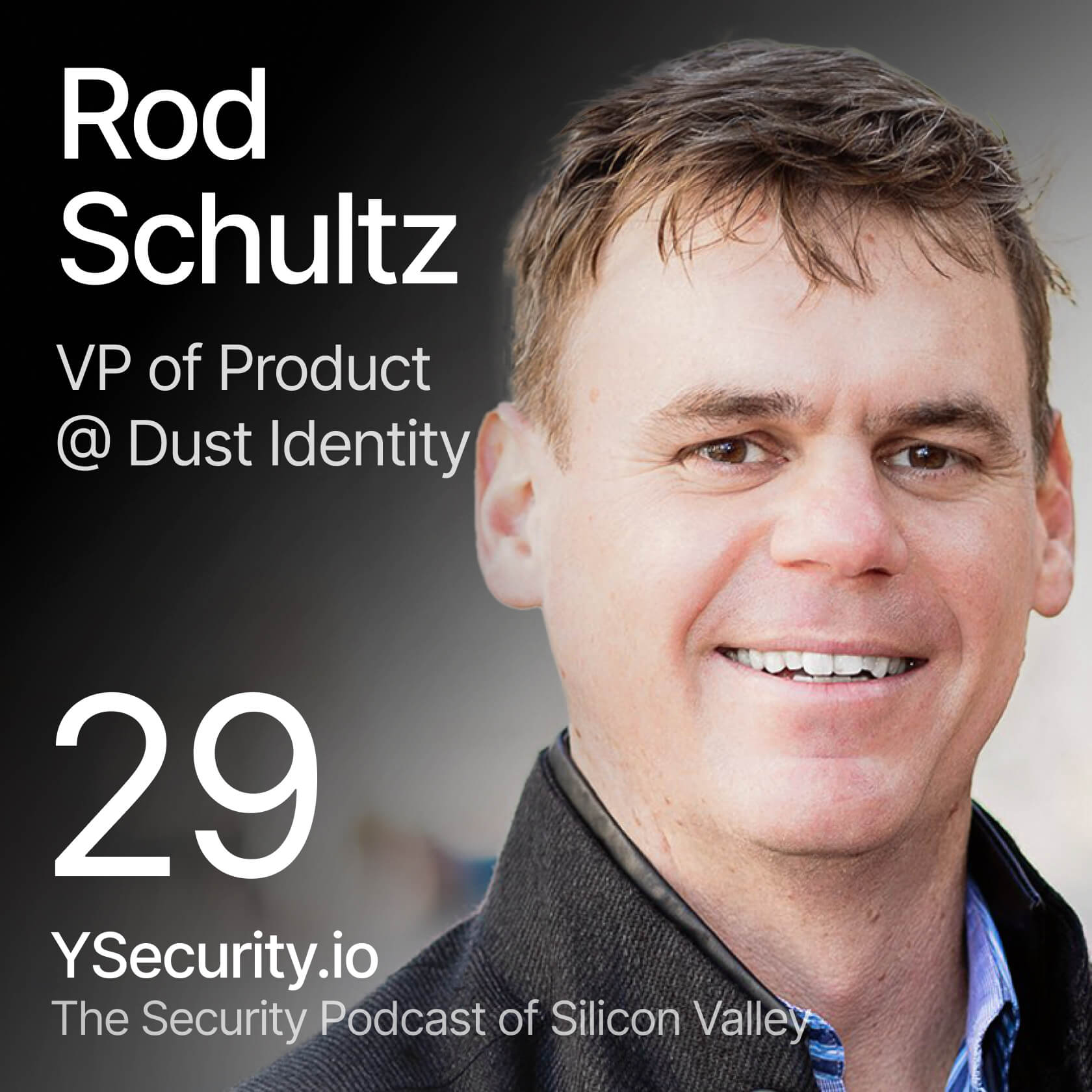
Welcome everyone to the security podcast in Silicon Valley. I'm here today with a super special guest, Rod Schultz. He brings to the table tons of security experience, product experience, working backwards through time. At the moment, he is the senior vice president of product at an exciting new hardware identity company called Dust Identity.
I'll let you get into that here in a second round. He's also an advisor for vPartners. He was the head of product security and privacy at Zoom for nearly two years. Very exciting role.
You are a technical advisor of product at Identify3D, a product advisor at Foxby. Did I say that correctly? Foxby? Foxby.
Foxby. My bad. You're also a business development and strategy consultant at Oasis Labs. You're the chief product officer at RubyCon Labs.
That was a five-year stint. At Adobe, you're the senior computer scientist project lead for primetime DRM. Oof, there's your roots right in your eye, your DRM. You're the co-founder and CTO of Pencil Networks.
You're also at Apple. You spent a good chunk of time at Apple. Before my time at Apple, but on the same team. Our shared heritage.
Our shared history. Look at that. Okay. You are the senior software engineer.
They're on iTunes SharePlay, which is, for everyone who doesn't know, that's the DRM solution that they dropped into iTunes back in the day when that was the cool place to get your music. And then later, your movies, your books, your apps, and all that stuff. Before then, you were at Cisco Systems. It looks like you came up through the engineering ranks.
And so, great to have you on the show, Rod. Fun. So, awesome to be here, man. Thanks.
It's been a long time in the making. So, thanks for making some time for me. Are you kidding? Anytime.
You're always welcome onto the show. So, how did you get into security? Yeah, that's an interesting question. So, I initially started out in college.
I was an applied physics major. Went from applied physics to applied biomedical materials to applied computer science. I took, like, quantum mechanics, organic chemistry, physical chemistry. But when I was in middle school, I got this book for, I think it was a Christmas or a birthday gift.
My birthday is in December. I was a big rule follower. And Sagittarius. Yeah.
So, I'm not a big rule follower. And I got this book. And it was called Spy Tech, I believe. And, you know, I kind of cruised through it.
And I was always fascinated by subterfuge and spy stuff and things like that. And then there's this one small kind of paragraph in this section on, you know, encryption and decryption or cryptography, I guess. And it was about this concept called public key cryptography. And at the time, this is, you know, back in the 80s, there wasn't a whole lot that you could find on public key encryption.
And they had, like, literally, like, one or two paragraphs of, like, hey, listen, by the way, there's this new mathematical technique called public key cryptography. And the key to lock the data is different than the key to unlock the data. And that blew my mind. At the time, I only knew, you know, common everyday algebra.
And I could not figure out for the life of me how if you had A and C, you could not solve for B in the equation. And I remember being so fascinated with this that in my junior to senior year of high school, we had to do something called, like, an iSearch project where you pick a topic and you have to just spend 10 months on it or nine months because we had the same teacher from. 11th to 12th grade. And so I focused on public key cryptography.
And I was like, I'm going to go figure out what this is. And I grew up in Durham, North Carolina. So I would go to Duke University's public library or their student library or the University of North Carolina, their library. And I would go through the microfiche of, like, old scientific Americans and, like, pull down these articles that were written on public key cryptography.
And that was kind of the foundation of me and my kind of random walk through security and what I thought security was or what I, you know, the beginning of it. Oh, I love that story. You and I may have had the same book as a kid. That's awesome.
Yeah. I had no idea. But it brought back memories for myself. So, no, it's huge.
Thank you for sharing. And that is fascinating stuff, isn't it, like, the public key cryptography? I mean, to this day, you know, I tell people, you know, what I, you know, you and I both, you know, kind of came out of the ranks of Fair Play at Apple. But which, you know, kind of put a lot of cryptography on the map, you know, in the public eye.
But I tell people that, foundationally, my career has been based on top of mathematics that didn't exist, you know, 50 years ago or 60 years ago. And that is, like, when people say, like, you know, hey, what should my kid do when they grow up? You know, my response is, hey, it's not very possible that the technology or the, you know, the mathematics or whatever your child is going to base their life on doesn't even exist today. It's really difficult to predict.
And so I tell people to focus on solving hard problems and solving problems that fascinate them that the world will get, you know, value out of. And it turns out that public key cryptography and asymmetric cryptography, whatever term you want to use, foundational to the Internet, foundational to electronic, you know, e-commerce transactions on the Internet. And it was really foundational to a lot of the stuff that we had to work on at Aqualine and Fair Play. Yeah, definitely.
That's awesome. It's amazing, Cher. It's funny how things that, like, look like they have absolute no use and then the context switches and then all of a sudden, like, the security of the entire world is based on this idea, really, of public cryptography. No one can sit down and prove, like, it's actually secure.
Right. Hey, on a side note, one of our advisors at one of the companies that you talked about, Rubicon Labs, which was the start of ours for five years, was with Diffie, actually. Right. And one of the reasons why I was very excited to join Rubicon, because I left Adobe to go to Rubicon.
And one of the kind of the reasons I left was they had with Diffie as an advisor. And I was really excited to meet him, just to see how his involvement in the company would affect the company. And I got to meet him several times. Fastly and guy, of course, you know, one of the founding, the grandfathers of modern day encryption.
So that was really cool. That's Diffie from the Diffie-Hellman key exchange. Yep. Based on the difficulty of the discrete logarithm problem.
Discrete logarithm. That's right. Yeah, absolutely. That's an ad must have been so cool.
That's like working with your hero, isn't it? Your childhood hero. It is, right? Yep.
And as they say, you know, it's sometimes, you know, be careful what you wish for it. It's dangerous to meet your heroes. Oh, I feel like there's a story there. Is there a story there?
You know, not much, you know, sometimes they don't always live up to, like, you know, your mental model of how they would contribute or how they would react to things. Well, I mean, I guess when we develop those mental models of, you know, little kids looking through spy books, it might be a little bit different. Yep. Okay, so now today you're at Dust.
Yep. Had this amazing career. You bring all this experience to the table. You've done startups.
You've done big companies. And now you're at Dust. Maybe you'd like to explain to our listeners, what is Dust? What do you guys do better than anyone else?
Yeah, happy to kind of give a little bit of the background. So I joined Dust in November. It's called Dust Identity. And they have raised, you know, venture capital around the concept of using diamond nanocrystals to put onto the surface of objects to give those objects uniqueness.
And a lot of people, the story is pretty fascinating. It's been around for quite a bit of time. So I started, you know, kind of talking to the co-founders back in, I guess, August or September of 2020. I mean, there was good chemistry between us.
Flew out to Boston, which is where they're located. Met a lot of the rest of the team. And it was a good chemistry. And I really liked this.
I'm fascinated by identity, of course. That's a foundation of, you know, a lot of security and encryption can be turned into identity concepts. And I was really interested in where to take it and how this identity could be leveraged, you know, to really create value for a lot of the foundational elements that Dust is going after in the world of military, aerospace, defense, collectibles, luxury goods. And other kind of physical objects and what that means.
So I started in November and I've been there for coming up on almost six months now. And it's been, you know, a really interesting, super fun ride. A lot of, you know, interesting challenges, which makes it, you know, really fun. And we're, you know, started to work on some pretty fast-looking projects with some really interesting potential customers.
And it's been very satisfying and rewarding so far. Excellent. Sounds like you're getting everything and then some out of your journey so far. Yeah, you always kind of struggle, right?
Going from these large companies to small companies. And my, the CEO of Aribicon, Richard Egan, would call this like the slalom where you would go from like the big company to small company, back to the big company, back to the small company. And I think, you know, that there's an adjustment going back and forth from a large company like an Adobe to Aribicon or a large company like a Zoom to a Dust. But, you know, both have their advantages.
And the small companies going from zero to one and really trying to solve some of those incredibly interesting hard problems to me is very rewarding. And I really like it. Yeah, I mean, I do the same sort of slalom, as you put it. I love that term for it.
I do it out of necessity, though, because, you know, you go from like a high-risk adventure to a low-risk adventure and recoup your like financial position. And then you do another high-risk thing. Like, just keep on doing this forever. I don't understand those people that retire, you know.
Yeah, I tell my friends and they're like, when are you going to, like, what is it done? And I'm like, you know, I like innovation. I like technology. And if you can do it with people who you have good chemistry with and who you can collaborate with and solve fun problems, it's incredibly rewarding.
So you mentioned chemistry a couple of times. I'm sure our listeners are super curious to just get a little bit of a glimpse into what that means specifically. Maybe it's one of those things you know it when you see it or you know it when you smell it sort of thing. But you have good chemistry with the founders and with the team.
What does that mean specifically? How does that precipitate? Yeah, it's interesting. I think one of the challenges that you have a lot of times, especially in today's world, is like there's this competition for if you can be the smartest guy in the room sometimes.
And I've definitely kind of grown averse to that archetype, I guess I should say. It's toxic, really. Yeah, it's really tough. And, you know, rarely is the smartest guy in the room like the richest guy in the room or, you know, the easiest person to be around.
And the day of like the lone genius in the closet, right, just like spewing out amazing concepts and everyone else prioritizing them is over. There's a lot of collaboration that has to happen in today, in this world. And, you know, if you can't collaborate in a fun, effective, meaningful way, especially in a remote way a lot of times post-COVID where a lot of times we're not in the same room. It's really hard to, you know, day after day, week after week to get the energy out, to invest the extra mind share, the extra time to, you know, solving those problems.
And, you know, chemistry really comes in. It's, you know, some of it can be like roles and responsibilities. Are they properly defined? But some of it can also be, hey, listen, like, is there a willingness to admit that you're wrong or a willingness to ask for feedback?
We were subject to feedback. A lot of those are dimensions of what I would consider, you know, elements of good chemistry for a team in general. Yeah. It sounds like a sense of humility and a sense of togetherness and a mentality of like, we're all in the same boat together.
And that I think when you get a bunch of people together, everyone is smart. We're just smart in different ways. And I don't know, I don't know about you, but like a true leader recognizes that and values those differences that different people bring to the table and can position different folks so that their strengths are shown. And a great leader should set their, you know, their employees up for success.
I had to hire a lot of people fresh because I put the entire security and privacy product team together at Zoom. And I had to hire like 13 people over a very short period of time. And what I would tell people as in the interview process was like, look, my job is to make it so that you can walk out of here in two or three years and do something amazing. And to set you up with problems that put you on, you know, a trajectory to be more powerful than you are today and to be, you know, and to pick and choose where you want to go.
And I think that's really important for great leaders to understand. And if you can line problems up in the direction of success of the company as well as success of the employee, you know, more power to you. And, you know, you've done some fantastic things. Yeah, absolutely.
Because at the end of the day, those are companies and companies do have to make money for their shareholders to be soluble, to build the next great thing does take money. So finding that alignment between great people and what companies need. Yep. Huge, hugely important skill for leaders to have.
What's one of the telltale lines if you have a leader that is missing something like that? It's a symptom that might come out of that. I would say lack of, like lack of interesting signal in the ring. So I've seen where no one challenges the leader in the ring.
Maybe out of fear. Or they'd put a lot of people around them that just amplify their opinion in some ways. I mean, I think a lack of curiosity can, you know, and just thinking can be a very good indicator. And just, I mean, as crazy as it sounds, like some people just lose their minds.
And when pressure gets high and they become, you know, just unreasonable and just not enjoyable to be around. So there's, you know, there's task conflict, which is great, right? If you and I disagree on tasks, that's fine. But relationship conflict is a challenge.
And trying to manage and balance out task conflict versus relationship conflicts and strategy conflict and all the things in a very quickly moving world. I mean, just look at where we are today and where we were 12 months ago. You went for, you know, interest rates have changed a lot. A lot of these companies are, you know, the conditions that these startups exist inside of are very different.
And if you can't have a good relationship and set diverse thinking and, you know, this acceptance up in that institution, you're going to have a very hard time surviving these dynamic conditions. Yeah, I couldn't agree with you more. And you really hit it on the nose with bringing and building diversity and difference of opinions and facilitating healthy conflict while mitigating some of that less healthy conflict. Yeah.
Personal conflict. That's what it's all about. You know, for myself, I always assume like two things and it makes conflict like super interesting. The two things that I assume is one, that everyone is smart, just in different ways.
Yeah. Right. Right. And the other thing that I assume is everyone wants to do the right thing, which means like when there's a conflict, somebody is either going to learn something new about how the world works or there's an opportunity to see the world from a different perspective or a different set of values where, you know, the right thing to do is something different.
That's super interesting. I love those moments. And it actually turns conflict. It turns disagreements into these amazing experiences where everyone can go home kind of with a little bit broader perspective or a little bit wider know-how about how the world actually works.
So, yeah, there's probably, there's probably a handful of times in your life that you can think, oh, I remember when I was in that and how impactful it was for me and what I learned during those times. And it's probably transformed through who you are as a leader, as a teammate, and as a thinker in many ways. And I think that, you know, if you can find those opportunities and grow from them, it's huge. So speaking of team building, what's your favorite interview question?
So I guess, you know, there was a question I used to ask quite a bit when I was an engineer. And I would ask it at Apple when I would interview people, I'd ask it at Rivicon when I would have to do technical interviews. And I would ask people to design a secure garage door opener with me. Oh, no way.
This is an interview question that I have used repeatedly myself. Yep. And so I know there were people at Apple who liked that question so much, they incorporated that into their repertoire of questions. And so that probably got passed down to you, maybe.
That maybe had ended up in an interview with me and somebody at Apple. That's right. That came from me because I would, you know, I mean, that came from, you know, years and years of just trying to figure out, like, what's a good way to assess the ability and security? And I would see people revert to like, okay, write some C code on the board.
Let's talk about an algorithm. Let's talk about like block ciphers versus, you know, other things. And I just didn't find that to be very interesting because it was just, hey, could they regurgitate, you know, some knowledge back at me? And I needed to understand if people could collaborate.
So we would start, you know, with this concept of like, all right, we're going to make millions of dollars on a secure garage door opener. What, you know, how are we going to do it? And it goes into like, okay, it starts out with identity and security and replay protection and all kinds of things like non-repudiation. And you can kind of start to build up different levels of complexity to your protocol because it starts to go into protocol design as well.
And just the understanding of what's the threat model. What are you concerned about? What's like repisable in some ways and what's repisable? Okay.
How are you going to do that at cost? How are you going to do that at scale? How are you going to do that at volume of transaction logs and things like that? So I found that to be actually like a fantastic way and to not put people on the spot and have them, you know, with their back to me for 30 minutes while they write C code.
And I'm just, you know, sending or receiving emails, which I've had people do to me at large campaigns where. I'm so sorry. I'm so sorry. That's such a stressful situation.
Yeah. Yeah. Unbelievably stressful. And I can't, I mean, I've had countless interviews where I'm the guy and they'll look up and they'll be like, hey, you missed a semicolon on that line of code.
Like, I'm talking about dry feedback, things that don't matter. That's right. It's like your garage door opener question was to me a really great way to see if I could collaborate and make it fun and see if I could enjoy. So it's so open ended.
They could take that in so many different directions. And I love that question because it lets the candidate drive and then you get to see where they're going to drive to. You know, are they going to roll the car right up to the edge of the cliff and say, look at all this? Yep.
Or are they going to like zoom in to the paint on the road and be like, here's how we paint the line on the road. And it's so many different places. It's an open ended. And you can give a little some nudges, some helpful nudges, introduce concepts that they had a thought about and just see how receptive they are to it.
And I found that to be very, a great way to evaluate talent, a great way to evaluate personality. So I'm sure all of our listeners are just dying to know if there's one thing that a candidate can do or to point out or say or just general energy can give off. Where you become like an absolute yes and you'll fight for this candidate. You'll fight to the death to hire this one candidate because they did something in the interview.
Really mentions. Is there any, is there any like for sure yes signal? And for that specific question or just in general? Just in general.
If a candidate can teach me something, I find that like, or give me some insights that I didn't know. And of course, like it really depends, right? Engineer versus product versus executive leadership versus marketing, right? Like there's a lot of different dimensions, but people that can give me some insights and it's not like a scripted insight or, you know, but it's like, oh, it's just kind of like a suck.
Oh, actually, no, you can't do that because of X4Z. And like, oh, and I find that to be fantastic because that's amazing. Again, I'm looking for people to compliment me and I'm looking for people who are smarter than me in general and their area of expertise so that they can lead and they are not afraid to point out where I'm wrong or to say, actually, this is a better way to look at that. It compliments you not in like, oh, what a fabulous sweater you're wearing, Ron, but like actually contribute to the gaps.
That's right. That's right. Yeah. To fill in where I'm either deficient or amplify where I'm okay and make those things better.
But it's also a fabulous sweater that you're wearing, too. Yes. Thank you. Well, I mean, I dressed up for the entire process.
I mean, I said you didn't have to do your makeup or anything. That's right. What's the best day that you've had on your journey so far at dusk? Yeah.
Yeah. It's, you know, that's a tough one only because it's just hasn't been, I haven't been at the company that long, but in February, I flew back out to Boston. And we were kind of at an inflection point. And I had flown, you know, I just started in November.
And I basically got buy-in from the board a couple of weeks before. So you kind of start focusing on what I call fast-moving water, which, you know, dust has been focused a lot on aerospace and defense. And we still are. But I felt we needed better or faster product, you know, iteration so that we could learn faster and understand what to build, what not to build, how to build it.
And we're stuck a little bit in, in like, kind of just contract stasis and things weren't moving. There's a lot of complexity and coordination. Contract stasis. Does that mean like in stock and negotiation, stock with an old contract, stock like servicing?
Exactly. All of the above. Yeah, all of the above. Like, hey, we don't know.
We're waiting for them to define this. They're waiting for us to define that. They gave us a picture. We don't know if that picture is of Earth or of Venus or Saturn.
Like, we're just not sure how to identify this. So there's a lot of malaise. Pluto. This story is not a plan.
Been kicked out. So we knew it was not Pluto. And so I got buy-in from the board and from the rest of the leadership team at Dust that we could focus on some fast-moving waters. And I flew back to Boston and put together a presentation to kind of motivate the company to buy-in.
And because the first 30 to 60 days I spent at Dust, I kind of wanted to just interview people and listen as much as possible. I didn't have that typical, hey, don't do anything for the first three months and just listen because we're a startup and you don't have that luxury. But I tried to get as many different perspectives as possible on what was good at Dust, what was not going well at Dust. And I got this overwhelming sense of a little bit of like thrash where people were being jerked from one space to the other.
And this is not unusual even in big companies. And I needed to make kind of like a pitch to the company that like, okay, I got buy-in from the board and from the leadership team, but I needed buy-in from like engineering and buy-in from sales and buy-in from, you know, marketing that this was a valuable and a viable strategy. And the feedback was overwhelming. People were very excited to go on this journey with us and to participate and excited, even though it was going to be a grind.
And it is a grind, right? I tell people all the time. That's a startup. Yeah.
Startups are tough. Innovation itself is hard because you're solving problems that have never been solved before. But that I found to be incredibly rewarding in that just the excitement and getting, you know, the buy-in from people was incredibly energizing for me. And I think incredibly valuable for the company and the velocity of Dust in general.
And so that was a pretty good day. That sounds like spectacular, just like you're on top of the world that day. Yeah. So I'm super curious.
I've heard that, you know, everything is basically sales at the end of the day. You're selling something, you're selling an idea, you're selling like, here's how to implement something. If you're an engineer, you know, if you're a security person, here's how to secure a system. A lot of this is sales.
And it sounds like that was no different from your experience at getting the buy-in from the company. Yeah. I think at the end of the day, best way to motivate people is through great stories. And, you know, that story needs to be aligned with the reality of the company and the reality of the challenges.
But yeah, in some ways, great stories are a great sales job. The greatest religions in the world are story-based. And some of the most successful companies in the world have fantastic stories, origin stories, leadership stories, product stories. Our brains are story-consuming machines.
We love stories and it helps if it's in the form or in the direction of value creation, which is generally what a sale is. It's a positive story. Something with a good and happy ending that people can jump on board and they feel all of the emotions as you climax through the story. Yeah.
So if you had any advice for our listeners who want to become more compelling or work on their persuasiveness, like what would you recommend as a good first step towards building up your storytelling muscle? Yeah, there's two kind of things I can touch on there. So one, I took a really great class at UC Berkeley and I don't know if they still offer it anymore. When I was at Adobe, Adobe was a fascinating place because they gave us continuing education money.
And so I took my dollars every year and would take a week or two at the Haas Business School. And one of the classes I took was a class called Art of the Pitch. And they brought in a bunch of movie producers out of Hollywood. And they taught us how to tell compelling stories or product ideas, which was, of course, makes a lot of sense.
Because at the end of the day, every movie is a pitch and it's just like this idea. But if you think about it, it was actually like the perfect foundation for trying to get people to buy into an idea. Because it's like, hey, can you invest $50 million into my movie? And it's going to be two characters.
This is the conflict. This is the resolution. This is the idea. And it really starts out as simple, something as simple as a story.
And so that was transformational for me. It was harder, a lot harder than I thought for that class to do that. And then I would couple that with, so like studying, you know, that idea, that art of the pitch and how to do it is interesting. There's also a book and it's called Resonates.
And it's by a woman named Nancy Duarte. And it's how to tell, you know, how to put together compelling presentations. I picked that book up when I first joined Rubicon, I think back in 2014. And that was actually fantastic.
And one of the key takeaways I had from that was that, you know, when you're on stage or when you're presenting, you're not the hero. The audience is the hero. And that was when I started to think about that, that made a lot of sense. Because your goal is to get the audience to go along with you, not for them to be amazed at how awesome you are.
So, you know, the analogy they use in that book is that, you know, you're not Luke Skywalker. You're Yoda, right? Or you're Obi-Wan Kenobi. Or, you know, pick your favorite, you know, hero.
You're not the main character. You're the side character leading the hero through that journey. The hero's journey. And the audience is that hero.
And any time I have to put together a presentation, big, small, whatever, I try and keep that concept in mind. And it's been successful, really, ever since I kind of grasped the intricacies of that. I actually have a very similar perspective on how to be compelling, persuasive. It does always go back to storytelling and connecting with humans.
And to not put yourself as the hero, let someone else step up and be that hero. And actually, there's another book that I would recommend to the listeners, Unleashing the Power of Storytelling by Rob Bisonback. And, yeah, and, you know, after reading that book, I always keep one or two stories kind of ready to go in my back pocket. And I can pull them out and share them in conversation.
And they always have, like, a nice little moral or verbal at the end of them. For me, connected to security. So you make them super personal. You can be super vulnerable in your stories.
And it also helps build trust in relationships with people, too. That's awesome. I love that. Okay, what about the worst day that you've ever had at Dust Identity?
I mean, it's still early days, really. Still early. Yeah. This is maybe not a fair question.
Yeah, I mean, you know, to be honest, we did have to do a layoff a couple last month or in February. That can be really tough. Yeah, that was disappointing. Like, you know, it's never easy.
It's never fun. And it's heartbreaking. So I would, you know, as cliche as I may sound, like, that was not great. I had to fly back to the East Coast and be a part of that.
And, you know, my heart breaks as I watch, especially in the tech industry. It's been a fascinating year. I don't think I've seen anything like this. You know, I started out in 97 at Cisco.
Went from Cisco to Apple to Adobe. You know, saw the 2000-2001 downturn. It felt very different. Saw the 97, the 2007-2008 kind of financial crisis.
Very different. Like, this is the first time I've ever seen the pendulum really fully swing against what I would call big tech. And it's been eye-opening watching it, you know, kind of ripple through companies that, you know, big and small. Wow, this is, you say this was even bigger than the 2000 downturn.
To me, it does. But, you know, look, I was very young. You were at the beginning of your career, maybe. You weren't in a leadership position.
That's right. And, you know, Cisco, I was at Cisco. They did a 20% layoff. And all of a sudden.
. . You were dodging bullets. Yeah, like, one out of every five people just disappeared at Cisco.
And, like, I thought there was going to be some ceremony around it. I thought we would have, like, a going-away party for people. Like, they just disappeared. And it quickly became evident to me that was the dirty underbelly of tech, was the creative creation and the rapid destruction and buildup of companies.
I saw it at Adobe. Adobe used to do, and maybe they still do, layoffs consistently around the November timeframe. And people would just get crushed. And it's awful to watch.
And the scale that I'm seeing now is something I have not seen. Maybe in the banking industry, they saw this in 2008. But this is the first time I'm seeing such scale across companies that have weathered these storms for so long. Yeah.
There's a human side there that is unavoidable and very emotional. I mean, look at what you get. You've got your health insurance. You've got your salary.
I mean, there's so many things that, you know, people build their lives on top of. And these companies are designed to scale up and scale down rapidly. And I just sometimes, you know, looking at it, I just don't know if we fully understand. These large companies fully understand just how disruptive and destructive it can be.
And, you know, in their defense, look, they're designed to take on risk and to scale up as quickly as possible if there's opportunity. But there's the other side of it. And it comes at some huge cost. And, you know, we suffered from that a little bit of dust.
And it was painful to watch. Yeah. Whether you're an engineer, an intern, or a leader in the company, it's painful to watch. Yeah.
No one wants to be in a position where you have to do one or be on the receiving side. That's right. Yeah. It takes away your autonomy.
And I think that's what's so jarring because you realize that actually sometimes we don't have a say in what's happening to us or happening with our careers. Yep. And it's like an external reminder, you know. Though if this does happen to you and there's, you know, potential for a package on the table.
I know a lot of places have laws around how this has to happen, including California. It can be, like, financially speaking, if you only look at the numbers and you ignore the human side of things, a very, like, the best way to leave a company. It can be the best way to leave a company. And sometimes it's the kick in the butt, you know, to, like, find another force to hitch your wagon to if you want to pick about it like that.
And, you know, a lot of people will talk about, like, hey, one of the best things that happened was I was forced to leave this company. I was on cruise control. Like, yeah, there's always those stories. But I don't think it's, I don't think you can underestimate the pain that a lot of the people go through.
Absolutely. Yeah. And not to belittle any of the emotions. And I think that those emotions are all very important and we should always feel them all the way through and find healthy ways to move forward with whatever change happens to be presented to us.
Yep. Through life. Yep. Well, how about a book or a movie that really left, like, deep and lasting impression?
Really, you've read it or you experienced it or you watched the movie and it changed the way that you see the world. Would you like to share with our listeners anything that just really, like, left a mark? And I'm trying to think. Helped make who you are today who you are?
Yeah. Yeah. I don't, I guess, miss. Maybe that spy book as a kid.
I know you talked about that one. Yeah. And spy book as a kid was, like, pretty great, actually, when I think about it. Yeah.
So I think as we go, like, super young. I remember my neighbor had a copy of the Anarchist Cookbook. I just thought it was fascinating when I was, like, in middle school. But parents were like, you're not allowed to bring that in the house.
But it just kind of made me gravitate more towards, you know, the quest for knowledge that you weren't supposed to have in general. Ooh, what is this and why am I not allowed to know it? Totally right. More recently, I did just finish, like, several months ago, the Tony Fidel build book that I thought was actually pretty well written.
And I thought that actually had some pretty interesting frameworks for how to kind of build up and build out a product team, what mattered, and a lot of times how to simplify some of the narrative around it. I felt, you know, that was, you know, kind of compelling. I guess maybe 20 years ago, I remember being in love with the book, Crypto Networkon by Neil Stevenson. Yes, that was such a big book.
It was, like, the only book larger than that was, like, Anne Reigns and Atlas Shrugged. Yeah. I don't know how well that book has aged, but at the time, I thought Crypto Networkon and being, you know, right in the middle of cryptography was just, like, amazing. And I would tell everyone to read it, and then people would look at it and be like, there's no way in hell I'm reading that book.
It's too big. Or maybe just, like, in my case, such a slow reader that would take you, like, years to finish. Yeah. Yeah, yeah.
Yeah. That's funny. How about you? What's, what are, I'm curious, books, movies?
Movies. So I watched the, no, thank you for asking. I watched The Matrix. Okay.
At a far too impressionable age. Okay. And just this idea that, you know, when the Wachowskis made The Matrix, I'm pretty sure that they had in mind, like, a very generic, like, hey, here's a system. What are the assumptions that the system is making?
How can we violate those assumptions? And it goes back to the security mindset. But in a very personal sense, it's also about social stigma and control and systemic sort of perspective on what are these institutions and what's good for people. Because if you're plugged into The Matrix, you didn't really know that you're plugged into The Matrix.
You're just, like, living out your life. Right? And the whole debate around the red pill and the blue pill, like, what's better? Like, which one would you take if you had the option?
Do you want the grit of reality and understand, like, what's actually happening and what's going on? Even though it might be a more challenging path. Might lead to more interesting, maybe more authentic experiences. Or do you just want the blue pill?
You just want to stay comfortable. And you just want to, like, enjoy, you know, what a steak tastes like, even though it may not actually be in your mouth, you know, from that scene from The Matrix. So, watching that at a far too impressionable age, like, and already having an interest in security, it just pushed everything into overdrive. And then.
. . And did your life crumble when you saw Matrix 2 and 3 and they resolved none of those answers? We do not.
And you're like, what's. . . How did you not, like, connect any of the dots on this?
Okay, so, like, the deal with The Matrix is the first one was amazing. And as far as I'm concerned, there was only ever one made. And those other things that had the name on it were cool action flicks and they had really good graphics and nice music, but. .
. Yeah, like, I would. . .
Matrix 2 and 3 existed. I will tell you, The Matrix 4 was, like, destroyed, is a crime against humanity. Almost at the same level as the fourth Indiana Jones movie, which I refuse to speak the name of. Which kind of destroyed my childhood retroactively because it was so awful.
I am so sorry that you were put through such trauma, Rod. Like, nobody should have been drawn through that level of suffering. Thank you. Yes, you're welcome.
You're welcome. I think it's important that we acknowledge the struggles that everyone has been through. Yeah. Yeah, so The Matrix.
You know, it's funny. Like, The Matrix came out and I think the Wachowskis were actually a little bit frustrated. And they were like, did nobody understand, like, what we were just talking about? Why did.
. . Why are things changing? You know?
And so they made V for Vendetta shortly thereafter, which is exactly the same storyline. Yeah. Exactly the same, like, philosophy. It's just a little bit more applied towards, like, government and society and forms of control and manipulation.
And they connected the dots back to the LGBTQ, like, civil rights movement. Which I super appreciated. Love that movie. At the time, I was going through, like, humming out and everything.
And it's like, wow. Like, another movie that, like, seriously reinforced some of these underlying philosophical principles of, like, do your own thinking. And systems are here, but they're also, like, have assumptions built into them. And you challenge those assumptions.
Like, really good things can come from, like, good things can come from, like, destroying old ideas. That's what. . .
That's progress. Like, getting rid of, like, the old way of thinking, coming up with new, better ways of thinking. Like, at its very core. Right?
And that's what I see as progress. And that's what it's exciting about being in a startup. Because you're presented with opportunities to do that left and right. Yeah.
No tomorrow is promised to no startup. And you better, you know, work like hell to try and solve hard problems. If you could go back in time, give your younger self a piece of advice that you think might be helpful or your list, our listeners here might enjoy sharing. What would that be?
If anything. Interesting. I think try and. .
. I think the advice I would give is understand the why or ask yourself the why. And the reason why I say that is, you know, when I came out of school, I was just interested in solving hard problems. And my assumption was that if it was a hard problem, it was worth solving.
So I spent almost nine years at Cisco trying to solve hard problems, but not really understanding the why. You know, I was just kind of like a cog in the wheel. And didn't really just have the perspective necessary to grow. Right.
I could grow skills in very narrow areas that created value for Cisco. But didn't really have this perspective and didn't, it didn't look through the perspective in many ways. It was just totally, you know, tunnel vision, blinded. And maybe that's the, maybe that's the curse of the engineer in some ways of like, look, why you're an engineer.
But I think asking the why and searching for the why, I think is an understanding of justification for what you're doing is pretty important. That really resonates with me too. You know, I had a very similar experience at Apple. I would wake up and I would be blown away that I would get paid.
And think about the problems that we solved, you know, in the DRM team and fair play. Yeah. And I loved it. I sunk my teeth into those technical problems super, super hard.
And I did that for like the first six years of my career. And I didn't understand why until it was like shoved into my face. Because you remember we had those old hands at the time, Steve Jobs was still leading Apple. And someone asked him a question in a company-wide old hands about like, what's the future of iTunes and DRM?
And his response, I remember, it was something along the lines of, you know what? DRM is stupid. We wouldn't do it unless we absolutely had to. But we have to enable some of these contracts.
Some of these contracts to happen on the business side of things. And in like those two or three sentences from Steve Jobs, like my world was shattered. Because here he was like threatening to get rid of DRM. And he wanted to get rid of DRM.
And he hated this team that I was part of. That you were part of as well. Yeah. And I brought with it like an appreciation for the why.
I was like, oh, I'm working on something that just enables some business deal to happen. Which was really important business deal. That's right. To have an entire team dedicated to this.
But it wasn't, you know, it wasn't everything that was all cracked up in my head that I had like conjured up and enjoyed from an engineering perspective. Like what it was. So I wrote an article for a French hacker magazine called The Many Facades of DRM. And it was basically intro of the framing of the story is about Steve Jobs and why he hates DRMs.
And it was really just a stick and mirrors game in some ways for Apple to control a market. Right. But yeah, that the premise of that was all about, I worked on this technology. We use cryptography to effectively create barriers to entry and do it effectively, almost too effectively in some ways.
Well, I mean, conversely, I can kind of understand like the requirement that came from the business side of the house, because my understanding is like those requirements came from like the content owners. That they had a clause in the contract that said like, OK, Apple, you're going to be responsible for making sure my content doesn't end up on Napster or Torrance. Because remember, like when iTunes was the big hot new thing, this was the era of content. And all of the music industry was suffering big time from all of that.
And you could imagine like that conversation happened between Apple and those content owners. Apple would go to them and be like, well, we're building this thing. There's these iPod things and we're going to put music on them and it's all going to be digital and on your computer and you're going to be able to sell your music. You know, on the computer.
And in the background of all of this, like content, those content owners were probably like, what are you smoking? Like, you know. So I also I synthesize with the supposed business need for DRM to just open that door. Yeah, it's a business enabler, right?
That's effectively what DRM is. It enables that business. But, you know, you don't want to be in the business of DRM unless you have to, because it's a tough game to be in. It's hard.
Yeah, it's hard because it is a barrier to entry and it does like limit what you can do with the things that you quote unquote purchase. Right. Well, super interesting discussion. Thank you so much, Rob, for joining me.
Really enjoyed the time. This has been fantastic. Super fun. Hopefully your listeners got a little bit of a viewpoint into the world of cryptography, DRM and products.
I hope so, too. And would you like to leave them with any like final words of wisdom? Yeah, good question. I don't know if I have any words of wisdom.
Then, you know, when people ask me like, you know, what they should focus on, I basically say, listen, there's really only a few ways to create value. And one of the most consistent ways I've found is through innovation. And so if you can innovate on problems that are hard, you will probably be very successful. And I encourage people to look for hard problems, try to be creative and innovative, but, you know, attach them to a business model, attach them to a problem space that either, you know, increases profit, increases costs, accelerates time to value or decreases risk.
And I will preach that, you know, until the end of time, because I find that if you can map a problem into one of the spaces and solve it, you will be very successful. And if you want feedback on any ideas that you're thinking about, reach out to Rod. His contact information will be on podcast description. And he's already an advisor for several very interesting and successful startups.
And so why not yours? John, thank you so much. It's been awesome, man. Rod, thank you.
The pleasure is all mine. Awesome. And thanks. Thanks all the listeners for tuning in for another episode of the security podcast here in Silicon Valley.

This episode covered SOC 2.
YSecurity helps teams get audit-ready without slowing the roadmap, from first scoping call to clean opinion.
Talk to YSecurity