14. Biff Clark, Cybersecurity Specialist and Owner of Coefficient Technologies, Frontiers of Cyber Security
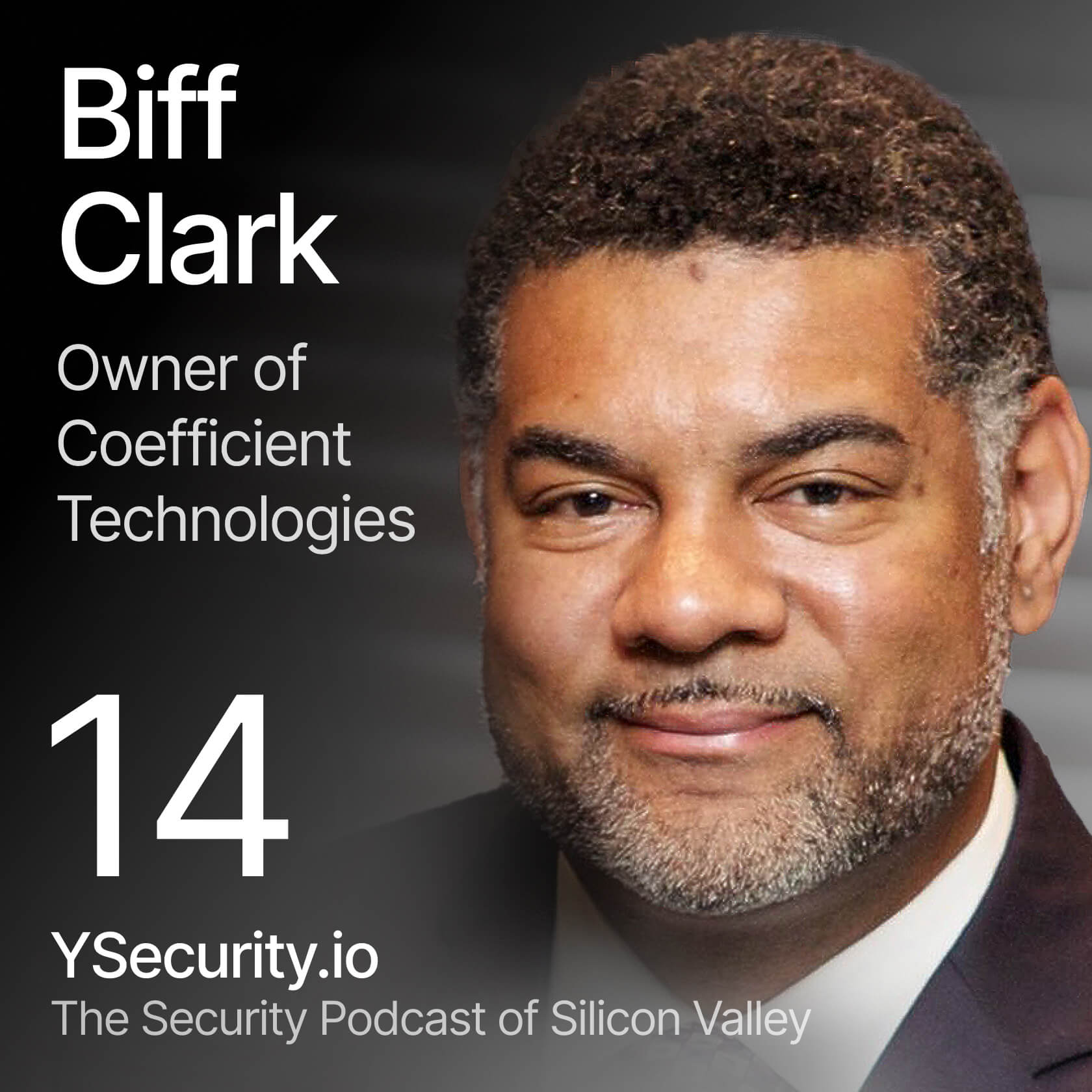
Welcome, everyone, to the security podcast of Silicon Valley. I'm here today with a very special guest, Biff Clark, a cybersecurity specialist and co-founder of Coefficient Technologies LLC. They've been around since 2004, focused on all things cybersecurity. Before that, Biff, you actually have a lot of philanthropic work here.
You're the chair of board of directors at the Hidden Genius Project, the Marcus Foster Educational Institute, Mindblown Laboratories out in Washington, D. C. And before that, it looks like you actually came in through the business side of things with a strong foundation in marketing and in sales. But if you've always had a special place in your heart for all things security.
You know, it was a passion later in life. And what was fascinating to me was, you know, I had a successful career working in the pharmaceutical industry, and I was fortunate to be somewhat fast-tracked. So I moved to a different department every 18 to 24 months. And you pick up these skill sets and then you reach a certain age and you wonder, are there other things I can do?
And so I created this make-believe retirement in my mind that I was going to retire at 40 or 45 if I could find a way to do it. And I found a way. So I retired from that industry and I said, okay, I'll reinvent myself and find another thing that interests me. And technology was something that a friend was talking to me about, and we were able to map some of the parallel skill sets.
And we just jumped in and that's how I ended up in the technology space and then moved into cybersecurity because I realized how difficult it was going to be for people to identify these threats and then protect their assets. And so the more you read about it, the more fascinating it becomes. Reinventing yourself. I love that.
That's similar to what Madonna does every couple of years, right? Very true. And to focus in on a hard problem. I know I'm attracted to difficulty and to solving difficult problems myself.
So I totally understand the drive and that pull. It looks like you went off and you got your MS actually in cybersecurity, electronic operations, and warfare. And you actually graduated with magna cum laude. Yeah, thank you for acknowledging that.
It's interesting because at some point I realized that, you know, this, not only is this the future, but this is definitely something I wanted to be part of. And knowing that, you know, when you, certain industries, when they go from trade craft to, you know, institutional, which is, you know, they start to build degrees around it. I wanted to be one of the early adopters. And so I felt no better way to really establish myself than to say I'm committed to it by going and getting an advanced degree in it.
And then integrating myself into the community, you know, both feet in and saying, hey, I'm here to stay. And so that was the motivation. And then just the relationships you build at that level, especially on the academic side, were key to, you know, helping me figure out how to really navigate the future. So I'm really glad I did those late hours and earned that degree.
Hard work always has a way of paying itself off, doesn't it? I'm super happy to hear that. So tell me a little bit about Coefficient Technologies. What do you guys do there?
Yeah, so we've been at it for a while. And we've had, you know, the typical things companies go through as you go through your maturation process. But, you know, we are cybersecurity specialists. And so our focus is really developing, you know, the companies that we work with to help them better understand cybersecurity.
You know, as we define as our area of expertise, you know, we realize the customer has to understand cybersecurity to properly deploy it in their environment. Yes, you can roll out a tool. Yes, you can check a box. But you really need to understand it.
You can't outsource the requirements around cybersecurity. You need to understand what people are doing for you. And so we believe in that. We believe that the customer has to understand how do I protect my employees and my users?
How do I protect my data? How do I protect my systems in the most logical way? And it's not always the most complicated solutions. Sometimes it's just smart solutions that address a concern and they shift behavior.
And if you can get some behavior modification, sometimes you can address some of the biggest threat issues that would be in front of you. Awesome. No, that's a really important component is not just to throw money at a problem, but to really understand how help your bottom line, help your top end. Very true.
Very true. And so I'm adding kind of a second element to it. So the reason why, you know, we focus strong. on just cybersecurity is because we realized that most people think of cybersecurity as a cost, but we think of it really as a revenue retention play because end of the day, you have solutions that help you protect the business that you spent your life building.
And it's sad that, you know, it can be taken away from you in less than three days if you get hit with a ransomware attack and you don't have experts around you to address it. Everything you worked for, the family that you feed, can all be lost in a matter of time. And we realized that that was one of the key elements that we wanted to offer as one of our differentiators is that, you know, we bring this expertise in-house for you to help you understand it and you will do the parts that we need to do to plug gaps.
And so part of that strategy was looking at the managed services model as well, where you now have managed security services and where you can now layer tools over an environment to plug gaps where they're not as strong. And then as you do your knowledge transfer and make either their in-house IT team or some of their cybersecurity professionals are more knowledgeable about the products, at least you're plugging the gaps while they're becoming more knowledgeable. And if they need you to stay, you stay. If not, then you know it's like an on-demand service.
You know, they pay their subscription fee for a month or for annual and you continue to provide services to them and then you become a trusted advisor. So we are, without a doubt, a reseller of cybersecurity tools, but we are a managed services as well in the consulting firm. So it sounds very similar to the VCISO role that has been cropping up where companies maybe are not big enough or don't have the resources to justify a full-time CISO to help organize and orchestrate all of the security needs, but definitely large enough that they do need some level of help and expertise.
And because it's tightly coupled to business decisions and operations and day-to-day operations, it's great to have someone in-house temporarily. Yeah. Well, particularly here on the coast, on both coasts, when you think about, you know, your highest salaries are, they're going to range from, you know, Boston down to Florida. And then the same happens on the West Coast from Seattle down to San Diego.
So to, you know, to hire, you know, a network administrator, a cybersecurity analyst, chief information security officer, they're expensive. They're significant investments. And so you have to think about, do I have enough work to keep them busy? And some companies, when they're in growth mode and all their money needs to go into, you know, research and development and really building out, you know, their growth plan, they may not have the resources to pay someone, you know, a six-figure salary just to sit there and just define, you know, how they're going to protect that.
Even though they know it's important, they'd rather use that for something else. And so that's where I think companies like ours can fill the gap for them for a period of time until they reach the stage where, yes, it's important to have someone in-house. So we can do like a CISO on-demand service because we understand the industry, understand the environments and understand the threats. Oh, that's excellent.
And I also see that you structure your company as an LLC. So what that tells me, just putting my Silicon Valley cap on for a second, is that you don't have traditional investors that have bought shares. Not today. You know, as we look at this managed services model, you know, we are considering that's the quickest way to really grow that.
You know, there's a lot of bandwidth that's needed to run a managed services company. You get into tier one, tier two services. You know, we've given thought to, you know, this may be a great opportunity if we wanted to really grow our footprint faster, then, you know, this isn't a pretty stable brand to do it with because this is the norm now is people are using third-party services to help with security to cover, you know, where they have a short amount of staffing. They may have some turnover issues and they need to make sure those gaps are plugged.
But the reason why we're an LLC is when we started out in the early 2000s, a lot of our work was around the subcontractor work in DC area. And so it was a pretty organic business. You know, you came in, provided a service. It was an open-ended contract.
You stayed in there for, you know, months on end, years on end. And then you grew basically through referral and networking. And so it was a comfortable business that you could continually expand upon and you added a service when you identified an issue. And so we were doing very well and very comfortable with that.
And the recession hit and things changed with that model as people start to close shop and shutter. And then you have to think about how do I reinvent myself? Was that 2008? That was right around 2008, 2009.
So around 2009, we partnered up with another boutique company that was really doing a lot of commercial business, but didn't have a service arm, which we were really strong at. And so we partnered with them for about three years. Started to just do that work and they started to make the shift toward federal and we started to see a stronger push toward managed services again. And so for us, we decided, you know, we had put our business on the side while we were doing a lot on the service work.
And we said, let's just start our company up again. And what we did is we reformed in 2014 and started pushing the managed service option. And so collectively, we've never stopped managing the customers that we had, but we did reintroduce ourselves again and did another launch, a soft launch. And now we've been going strong in the managed services space.
No, that's wonderful. I'm, that's great to hear that you've been able to identify the shifts in the market and just like water flow with it instead of fighting the current, fighting the times. You said the magic word for all investors. You said subscriptions.
Yeah. So is that how it works? If I wanted to subscribe to consulting, then I pay a subscription fee and then I get maybe more help when I need a little bit more help and a little bit less help when I don't, when things are just smooth sailing. Yeah, absolutely.
Because you need to, again, as you stated, you have to be able to adapt to the market space and what the needs are. And so companies have strategic plans that they need to work through and fulfill. And so you need to be able to ebb and flow with them. So the way our managed service model works is, you know, we provide the solutions that you need.
They either support what you existing have in your environment, and then we can roll that into our security operating center and we can manage those components for you. So let's say you've had some turnover and you haven't been able to hire the person that you really wanted, but you had to find a junior person that has maybe two years out of school, a little bit of work. They've been an assistant, but you need someone that really understands how to do security analytic work. And so we come in, lay our tools over the top.
And so they may need that for a year. They may need it for 18 months, or they may be acquiring another facility and they need to add some stronger tools on top of a company where they identified that they had significant vulnerability, but they need to get that organization up and running with their tool set as soon as possible. So yeah, we work the subscription model. It's a lot easier than saying, hey, I've got to lay out this fee for three years in advance, but we definitely can see ourselves growing into it.
No, that's excellent. I like the business innovation there, because usually subscriptions aren't thought of as connected, I think, to the human services, but I like that. That's a nice touch. And you use the first person plural.
You were talking about we. And so you have a business partner in with you? I do. It's an actually very fun story for me.
My business partner, Dennis Moore, and we've known each other since childhood. He and I went to the same high school. We played on the same football team. We were really good friends, fast friends as well.
And come to find out that, you know, my brother had bought a horse for his daughter and he used to take her to, you know, the stalls and they would ride around. And Dennis's father, you know, also had done that for he and his brother. He met my brother when he was like three or four years old. And so he's been in the family, been around the family, you know, my entire life.
But we really connected, you know, when we got to high school. And so he went on to the Air Force Academy and got his degree in human factoring engineering. I went on to a school in Nebraska where I'm from and ended up getting a business management and a finance minor and received a football scholarship to go down there. And then after graduation, some years later, we reconnected in the D.
C. area. He was assigned to Andrews Air Force Base after coming out of the military and working in the cybersecurity space for Boeing and also Andrews Air Force Base. And then I was transitioning down to D.
C. through the pharmaceutical company and we just reconnected. So long time friends and we had an idea about working together and he happened to be in the space and this was our chance. So we went for it.
No, that's great. And so you guys already had a solid foundation. You had, they were both family friends. And so the trust was there.
You didn't have to worry about it. Any of those messy like founder dating scenarios or those sometimes awkward discussions. Yeah. The thing, though, is I think with anyone, you spend so much time together.
You've known each other for so long that you still have these, you know, brother fights, though. Oh, of course. I think it just comes with the territory. Yeah, it does.
But we worked through it. You're going to be honest and you're going to be straightforward. Then that's that comes with a textured relationship. Let me say.
Absolutely. And there's no other way to do those. Right. You got to bring your full self to the table and invite everyone else to bring their full self to the table.
And there's going to be differences. And that's where teams are actually, you know, better than the sum of. There are individual parts, and you come together, and you can discuss and make a decision about what's the best path forward, trying on each other's perspectives as if they were a pair of sunglasses or something. That's right.
And you still remember their tics. So I remember, hey, when you were younger, you used to do this, so I know what's going on. Yep, yep. If you can read them, that also helps, you know, it bubbles up all of the, all of those pieces.
Yep, absolutely. So it's been a good relationship, and, you know, he's like a brother to me, but more importantly, you know, we're focused on success for our families, and, you know, we're, we have the same motivations and mission. Do you guys have any employees with you? Yes, so right now we're a team of five, and, you know, we've worked with these individuals now for the past four to five years.
Our traditional model has been more of a consortium, especially in the security space where you need expertise, and it's hard to have that on staff when most of the time you're trying to run lean unless you have long-term projects that allow you to put a person on site. So we deal with a lot of subject matter experts, but our current five team, our team of five involves, you know, two additional engineers as well as a sales team, business development team, and then also an enterprise salesperson, and the majority of those folks are managed on the East Coast, but we do have a national footprint. It's more than just you and your partners.
It's those guys too, and I'm happy to hear that you even have the business development folks in-house now too. Somebody's got to help you with this stuff. Yeah, exactly. It's a lot of work in that department.
I understand completely. No, thank you so much for the childhood stories too. It's great that it went back to your meeting your partner, and it's just now, it's funny how the universe has a way of just working things out for us. Yes, it does.
And I couldn't have a better friend or partner, so he's been there for us and my family for years, and he's always been a stand-up guy. And you want to work with people that have integrity and character. And one of the great things about his military background, because he followed his father into the Air Force, but except he was able to go to the academy, was he just has high integrity. And in this space, that's very important.
Very important that you say what you mean, you can deliver on the services, and that your focus is always the customer. You're focused on the customer and what their concerns are and what their needs are, how you can help them better understand how to protect their businesses. And they need people they can trust. You know, we fight every day to become a trusted advisor so that they can ask us any question, even if it's not for services that we offer.
We're trying to protect them because we believe that that's the mission. You know, we have to give people better defenses. And sometimes it's intellectual, and so we can invite them to go talk with someone that we know. And sometimes it's the solutions that we offer, but we all win.
Yeah, that's the way to do it. To build relationships, you need a foundation of trust. To have a foundation of trust, you need to preserve your integrity. And, you know, when you talk about high performers, you can have high performers that are very smart in a particular area, but if you don't bring that in, you know, the sense of integrity along with it, then, you know, you're missing something there, 100%.
And that's where I believe leadership really bubbles up from. It comes from that strong foundation of trust and integrity. So you can have real relationships with folks. You can have vulnerable moments and trust that you won't be taken advantage of, that you have everyone's best interests at heart, right?
Absolutely. If I was to just add some life lessons for myself, I think, you know, you have to treat people the way you want to be treated. And that involves being honest about situations where there may be a learning curve issue. There might be an availability issue.
It could be anything, but you realize that, you know, if you want to do, you know, good work, then you're going to have to meet people at a place that allows you both to understand how you can get this done. There's a lot of high expectations in this space because it's similar to policing in some regards where it's only when the phone call comes in that there's an incident happening that you're called to duty. Nobody just rolls up to you and just says, hey, I want you to know everything's going fine. Can you just do this to be, you know, to help me have a kind of a gold standard to understand where we are?
That seldom happens. It's usually an incident that you have to come in and address. You know, the intensity is high. The energy level is high and questionable.
People are somewhat suspect. They're questioning folks on why things happened, but yet they need to pay you to resolve it. They don't know what that dollar amount is going to be. You don't know what that dollar amount might be.
And you have to find a way to get them to realize that you're there for their best interests and you want to get this done as soon as possible so they can get. Back to doing what they do best. And so you really have to navigate that. And as you stated, you know, they have to believe that one, you're trustworthy and you're not going to try to take advantage of the opportunity, but you're going to do, you know, what you think is logical and reasonable to get this done at an affordable price, truthfully.
And that could be, you know, a couple hundred dollars. That could be a couple thousand dollars. It could be a couple hundred thousand dollars depending on how severe their environment is. That's one of the reasons why, you know, proactive sales can be very tough in the security space because when everything is peachy and it's easy to push the sort of the risk analysis and the gold standards, I guess, as you put it down, oh, that will be good for next quarter.
That will be good for next year. It's a good problem to have, you know. And then when you do have that problem, uh-oh. That's why I pushed the phrase, you know, revenue retention because they see it as a cost.
They're like, this is CapEx, you know, we got to do this. We got to pay this much money for this service. But at the end of the day, if something happens, there's, you know, you're going to take a hit on your brand. So brand recognition, you're going to take a hit.
You're going to take a hit with your employees because they may have an unstable environment. They're not comfortable there anymore. You may take a hit revenue-wise. So your whole objective is to make sure you make more money year over year, not, you know, have this $2 or $3 million that gets snatched out of the coffers because you didn't want to pay for a particular solution or a person to come in and actually lay out a real strategy for you.
Yeah. So actually, one of the questions I like to ask folks is, what's the one truth that you see in the world that most people miss? I was thinking about this, and I believe the, all of the social challenges and social injustice and issues that we've had to discuss throughout the country in the past, almost two years now, it has brought this to light. And I believe that most people want to do the right thing and most people are good people.
I feel like, and most people want to help. They don't want to hurt. I believe that people understand that being on the wrong side of anything is exhausting. You know, we find that it's very challenging at times because we're brought into crisis situations.
And if it's a refresh where, you know, they've waited too late to decide, you know, to really evaluate a solution, they've got to make a solution in 30 days, that creates anxiety. Or an incident happens, privileges are lost, someone misplaced a fob and they know that they had access to some highly sensitive information. They've got to figure out if there's anything that's lost. So it creates a situation where companies and individuals and leaders want to do the right thing.
And oftentimes there is something that may be preventing them from making that decision today, but they have, you know, a long-term objective to address it the right way. And so what we spend our time trying to do is helping them, is to help them make those decisions sooner to realize that it's in your best interest to address it now than to push something down the road. If you want to do good, then let's think about, you know, how you're going to protect your organization, how you're going to protect the employees that manage sensitive stuff, how you're going to make sure that, you know, you're able to feed your families, you know, down the road, not just through this quarter.
And so we try to focus in on making sure we can identify and that we can relate to the individuals that we deal with. Oftentimes I've found as a minority business owner, there's a disconnect in some of the social structures that we deal with. And a person that's not African-American doesn't really understand an African-American's life, but they oftentimes don't think about the fact that we have a lot in common. Like we both put our pants on one leg at a time.
We both enjoy eating pizza and drinking a beer. You know, we have a lot of things in common. We both love the 40s. We both ride motorcycles.
There you go. Yeah, we ride motorcycles. We both like security. I like to provide solutions.
You like to protect environments. There's a lot more things in common than probably the things that we have different. And the goal is really just getting folks to see that, you know, I'm a good person because I believe you're a good person and we need to find ways that we can relate and how I can be a service to you. And sometimes when there's a difference in race, it's easy for people to dismiss because they don't realize the consequences of a situation.
If you've never lived my life, you may think, oh, he doesn't care. He'll just go on to the next customer. But I got to feed a family too. You know, I've got to pay a mortgage, pay for a car, and I've got to keep my employees happy.
So there are things that we can identify on. And when we find those, then I'm here to help. That's what my job is. I'm a firefighter for you and give me the same chance that you give everyone else.
I feel the love, the passion, and the drive, and the connectedness. Maybe that's a really good word. I feel the connectedness. Yeah, we're always trying to do that.
We need it now. And so I think it's been hyper-exposed since of all the issues that we've had in the country. But I think just even in business, people need to be more focused on, you know, how do we make sure the intelligence that's needed to protect folks, you know, are in the same room, you know. We're all in the same boat, right?
Yes. On the Titanic. No, please, let's take the Titanic as a lesson learned and not go full steam ahead in the dead of night, you know, in a dangerous context. I agree.
A hundred percent. No, and I appreciate you bringing up the race question. I was actually just having a discussion with a friend around the 1960s and the MLK speech and how it was a time that facilitated great change and great positive change. And it really helped build the world that we all share today.
And that even today, you know, with George Floyd and everything that had just happened there, that there were a lot of parallels to the 1960s and all of the work that had been done. Mixed feelings in the sense of, you know, sadness that we're not further along in a lot of those social justice issues, but happiness that it is actually coming up and it's being a subject of discussion again. So we can improve, we can continuously improve. I'm not sure it's about a destination.
I think it's more about the journey and appreciating that we're all imperfect and that we're all different, but at the same time, we're all connected and we're all in the same boat together, just as you were saying. Absolutely. Absolutely. I think if I was to add to, you know, what you said earlier too, you know, success and education and just learning in general requires, you know, commitment, discipline.
It's hard work. And our country is going through a shift and it's hard work to get people back on the same page, to buy into, you know, the values of a system as it's evolving. And, you know, I see our country is trying to figure that out. And I'm really glad we're trying to figure that out.
And then folks have a voice and they're willing to express themselves and share their perspectives, opinions, and the experiences because that knowledge needs to be shared and vice versa. I think that those that are in, you know, the, you know, the shape-shifting world of politics, of industry, of all of our social challenges, they need to hear these types of storylines so they have better or more data points to make better decisions.
And when you think about, you know, whether a person is, you know, white, black, brown, or from, you know, other countries that we represent now in the United States, it's important to understand that, you know, we are all at some point an immigrant and that we all are here trying to find a better life and that we are here trying to make sure that our borders are safe and that people have an opportunity to fulfill their American dream. You know, they bought into what the constitution said. And so by that, by default, you know, we have to provide them with all of the elements that are in the constitution. Yep.
Equal opportunity under the law is supposed to be blind, right? No prejudice. No. Couldn't, I couldn't agree with you more.
Okay. So tell me about the best day that you've had at Coefficient Technologies. What was that day like and why? It's a continuum for us.
It is a continuum. The way that we launched the company, of course, because, you know, we were, we believed we had something and we wanted to go out and prove it. And then we did. We went out and proved it.
And so that has always been, you know, the exciting day where you sign on the document and say, Hey, this is the official company. There you go. Yep. But the reason why I say it's a continuum is because every time a customer says thank you or thank you for helping us, or this is great.
I still get that same feeling because we mean, not only did we buy into our mission, they understood it, which is we are here and we're customer focused and we want to solve a problem for you. And we want you to get back to business and feel confident, you know, reassured that the solutions that we provide allow you to do that. And especially if they're switching from one solution to another, there's that hesitancy. Is it going to work the way you said it's going to work?
Or you solved this problem. We're now back up and running our network. Working again. It's just the sound in their voice these days, you know, which used to be in person, the look on their face that says they're a satisfied customer, and that means that we're doing well.
We are fully in our mission, and it gives us another day to go out and sell that service and share that experience. And I'm always overjoyed when someone's happy with the work that we do. Excellent. No, I love that because then it's like an opportunity for the best day to be yet again tomorrow or the next day or the next day on average.
I believe in Groundhog Day. I want that. I want that. OK, all right.
I love it. OK, so what about the worst day? Has there been like just a horrible day that you've had at Coefficient Technologies just for who knows any reason at all? And you clearly have navigated it because you're here and you're successful and you're sharing all of these great stories.
But oftentimes other entrepreneurs who listen take great advice from experienced and successful leaders like yourself. I do actually have a story and, you know, I talked to my partner about it because, you know, it was an emotional story for us. A few years back, you know, a good friend of mine, a mentor, was chairing a board and said, hey, I've got a problem with our existing IT team. They're contracted.
Can you come in and replace them? I'm just not comfortable with everything they're doing. There's not enough transparency. Can you come in and help us out, figure it out?
And what I thought was going to just be a scoping exercise, maybe an audit and lay out a report that says, here's the recommendations for changes, turned into, hey, we need you to sign on this dotted line and, you know, you're going to take over this service. And there was some trepidation there because we're like, ah, we haven't had a chance to fully scope this environment. We're not sure where you are as far as where you want to get to, where's our starting point. And because he was a good friend, we agreed to do the contract.
And when we started to dig into it, it was a nightmare. And we were bi-coastal. And so it was a nightmare because we started to understand they didn't have, you know, they didn't have service contracts on their network. They hadn't deployed solutions properly.
They were under-resourced, not only financially to address the network, but even bodies. There was an actual coup d'etat that took place where people walked off the job site and said they're not coming back. And we're sitting there going, how are we going to handle this? And in this particular case, they were doing a major rollout when all this went down.
And this is your friend, a good friend. This is my friend. And he was telling me, thank you, but it was worse even before that, is what he was saying. So he was telling you thank you and you're like, wait, hang on, hang on.
It was just, and so at that point, we knew we were going to be the bad guy in the relationship because, you know, there's relationships throughout the organization that they were long-term and they didn't understand the scope of really what was going on or how bad it was. And so I remember my partner, Dennis, so he would have to wake up at 3 o'clock in the morning and the system resets every day just to make sure that we could get this system up and running for the particular rollouts that they had coming, you know, that were scheduled like every other week. And, you know, we had to hire a team, bring them up to speed on a network that we couldn't really give them full knowledge.
We were just an hour ahead of them from a knowledge-based standpoint. We would think about it and tell them how to do it. We had to hire a lot of third-party consultants. So that chewed up a lot of the contract money.
And we finally got to the point where we were ready to roll out a new system. We had found, you know, a bucket of money that could cover, you know, new solutions and also new hardware so everything would have a service contract. I love it when you find a bucket of money. It just happened.
He pulled it out of something and he finally let us know. And then right when we get ready to, you know, to make the, they decide that they couldn't afford our services anymore. But they wanted to hire our team. Oh, so wait a second.
They want to buy the entire company at this point? They're just like, yeah, we'll bring you in-house. Keep doing this. Thank you for the work you did, but, you know, you guys are too expensive for us, you know, based on all the work that had to be done.
But we do the guys that you do have here. Can we hire those? And so the difficult decision for my partner and I was the two individuals that we hired. They've got families to feed, and I can't pull them off this contract if this is helping them meet their day-to-day responsibilities.
And so we worked out an agreement that allowed us to separate and retain some of the money that's owed to us. And those individuals now work on that site. But it taught us a very valuable lesson. And that is, you have to scope an exercise, or you have to scope an environment prior to assessing what your cost might be.
Because there were a lot of things that we decided to, having that honesty and that integrity, because, hey, you know what? Let's just cover this cost for them. And we did that because we were trying to do the right thing. And I'm still glad we did that.
But we realized we walked into a show that has some manure on the front of it. Yeah, I know what type of show that's called. And when we got out of it, it was a relief. But we wish we could have turned it completely around.
So it didn't all fall on us. But when you come in and you do contract work, you have two goals. Get the contract, complete the contract. And so complete the contract is 100%.
And when anybody tries to prevent that from happening, you take some of the onus there. So I was sad that we didn't get to roll out that new environment because that would have solved a lot of their problems. But when your friends call you, pick up the voicemail. Don't answer the phone.
Put them to voicemail. Okay, that's funny. Think about it. No, it's good.
It's good. When you shared your earlier story of, you know, you had a childhood friend, a family friend, and you go into business with them. I'm happy that, you know, when you mix friendships and you mix business, that can be, I don't want to say a conflict of interest, but you will give people more benefit of the doubt, I think, in certain situations. And cross your fingers, hope for the best, I'm sure.
It sounds like it was no one's fault in particular, but it's just a difficult situation. Are you still friends with the guy who. . .
Absolutely. He's a phenomenal person. And we did good work, you know. But, you know, where we set the bar and where we got them to, you know, truly kept them functional.
You know, they now have a team that's solid, that has all the experience, understands the environment. They didn't have it before. So they got everything that you gave them and they just ran with it. And now they're in a much better position and they've got some.
. . They are. They're much better than where they started when the coup d'etat happened.
Well, there you go. So you got, that's a success in my books. I don't know. Yeah, that's definitely a success.
I love how your worst day is still a smashing success. That's fabulous. That's wonderful. So if you look into the future and you look out into the future with your visionary lens on and you see Coefficient Technologies and you see it a smashing success, what does that future look like?
And how far away is that too? Actually, I think the future is now. And the reason why I say that is because, you know, the world did this quantum leap with the pandemic and the shutdown because there was always this concern. And you were part of this, so you understand this joke, which is, I don't believe in the cloud, but I'm going to send you my response via Hotmail or Gmail or AOL, right?
So don't believe in the cloud. But did you get my email I sent you in the cloud? All right. Clearly, all your information is running through it, right?
So it was a comical thing for folks that, yeah, you don't believe in putting data in the cloud. But now with the shutdown and everyone was a remote worker, it fast-tracked managed services. Yes, it did. Completely fast-tracked it, which also meant it fast-tracked the concept of reducing your overall footprint.
There's more services you can put in the cloud now. You realize I don't need to have these huge data centers. And not that folks, you know, will lose their jobs in that space. They'll just shift them over, maybe retrain them and teach them other skills.
But now it's like you can reduce your footprint, which helps, you know, from a greenhouse gases standpoint, which allows you to be more efficient by allowing you to reduce not only the amount of money you spend on leases, but also the fact that you can get better tools, that you'll have better security tools that are being managed, you know, and patched, you know, 24-7, 365, than waiting for a patch to come down and making sure that it's in your project pipeline that says, hey, we're going to do this 30 days from now. No, they're taking care of that and the updates are happening more consistently and more frequently. So we believe now that the whole managed service model is upon us.
This is a new age, and we feel that's really where the growth is going to take place. And so we are primed to just do more business in this space. And, you know, if I had two more hands, you know, I'd be able to do a lot more than what I do now. But I'm excited about that.
So the future looks bright for us because of the space we're in. And we started this maybe 15, 20 years ago of thinking about just cloud services. So we have an expertise in it. But that's key for me.
The other thing I think is important is customers, there's just more and more businesses starting. So it's almost a restart. When the country goes through these type of recession-based model challenges, you know, a whole new set of companies start. And so there's a new group of folks that need help.
And so for us, it's just a recycling of opportunities where you now can work with maybe a little smaller company, but they need more help than some of the more mature ones. All of that resonates with everything that I've seen and noticed, especially with the recent reset with the pandemic and everyone just stomped on the gas when it came to managed services. It is one even more interesting point. And so we are a managed security service because managed services, they're not in the cybersecurity.
They're just doing the bulk of it. And so managed security need, managed services need managed security over the top of their environments. Yes, they do. And so we're finding that is even a new opportunity for those that went out and built big managed service businesses around Office 365, Workday, some other offerings.
And they need tools now to make sure that they're not vulnerable because now it's just one choke point. If a cybercriminal gets into a managed services, they take down companies all around the country. And, you know, the managed service person has to think about how am I going to protect my environment because that's now part of my requirements to make sure I'm secure. And I need to make sure that folks have cybersecurity insurance too.
You know, we're finding we're helping more than just the end user. We're helping our end users also manage services too. What do you see the future of the cybersecurity insurance being with all of these ransomware attacks and costs going up? Yeah, it's going to go through a level set.
They're going to have to determine what tools will be part of that requirement in order for people to have a level of confidence that you just can't do just a simple checkbox of a tool. So if you are a, and they'll probably tier it where you have, you know, your small, you know, LLCs and S-Corps and so on, and you move on up, but they'll make sure that people are using quality products that have a level rating that says that they are able to defend against certain things. So you can be a 10 person organization and you may just go and buy the Norton product.
Norton may say we have a personal option, but the cybersecurity insurance will say, no, we will only secure you if you happen to have the business or enterprise version of it. And we'll continue to do that with other tools and say, here's the set of tools that we will support and ensure. And then we'll make sure that you're doing all the requirements around, you know, behavior modification, around best practices, around cybersecurity awareness training, what you're doing as far as backup and how are you doing your redundancies as well as your disaster recovery plan. There'll be more requirements.
And that just helps our industry because we bring that expertise to the equation instead of them trying to figure it out. It's like people doing their own taxes. Yes, you can do your own taxes, but when the IRS calls, you know, you have to answer those questions. Why not take them to a professional and let that professional answer those questions for you and do your taxes because they may find a couple other things that you didn't think about.
And so I feel like we're similar to that. Let us do your taxes. Let us do your cybersecurity and you'll be better protected and better prepared when an incident happens to respond and be back up and functioning. Yep.
That's a great analogy. It's a great analogy. And I was just glancing at your LinkedIn here too. And it looks like you are connected with Prakash Darji.
Does that name ring a bell to you? He's the general manager of cloud services over at Pure Storage at the moment. He is anyway. Before that, he was at SAP.
Did a couple of other things from SAP. Yes. So there was a neighbor of my wife and I in San Francisco. And we shared, like we were in this building where the windows were almost a pass-through where when they were in their dining area, they could see through our bay window, which allowed them to see the bay.
And so if we ever closed the doors, they would be like, no. And they couldn't see the bay. And so he worked with that family because that individual was an EVP at SAP. And he had come over for, I would say a makeshift happy hour, and we all met.
That's initially how we met. And then I was working with another company. I was representing another solution where they had a product that identified bugs in the SAP HANA solution. And so I had a one-on-one with him to talk about, you know, the way I could present this product as a service offering to support the work that they were doing to roll out the HANA product, which was a very difficult rollout.
The conflict is they're trying to sell the product, not let people know that there's problems with it. Right, exactly. No, it's funny. What a small world.
The reason I brought up Prakash is he was actually on the Security Podcast in Silicon Valley a couple episodes ago, and he was speaking. He resonated exactly with your message that the future is going to be services and that we need to focus on the security of those services and solve those hard problems with abstraction layers and so on. It was great. It was great.
Wonderful gentleman. Met him a couple times, but was very kind, very knowledgeable, and I was glad I had a chance to meet him, but I haven't talked to him in years, you know, but now that I know we have something in common, I will ping him and say, hey, you never guess. We have in common what we have in common. That John McLaughlin guy, the Security Podcast of Silicon Valley.
Yeah, you both have been on it now. I reported up through his chain at Pure Storage when I was at Pure Storage. I was in cloud security, so. Awesome.
Well, that's awesome. I love it. It's a small world, isn't it? Okay, so one last question.
What's your favorite interview question? My favorite interview question. My favorite interview question is when I'm asked, you know, what do you think shaped your life? What do you think has made you the person you are?
Because it's, you know, you rarely stop and reflect on what you think those pivotal moments are. And it's a kind of homage for me to tell people, you know, there's a lot of things that happen, good and bad, that help shape who you are, but how you approach life allows you to determine how you treat people moving forward. And we see that every day. So that's usually one of the questions because I think back and I show respect to those folks that really helped shape me.
Fresh out of college, had landed a job working at a company, and I wanted to work in sales. And I was, it was a small family-owned business and most of the family was the salespeople. And they were like, ah, no, you know, my brothers and sisters, they're the ones that do the sales. But I was so desperate to get into sales, I decided I'm going to leave.
And I left the company and I took a part-time job during the holidays working in retail and figured I could do this for three months, get through, you know, November, December, early January, and then keep my resume out there. It's back in the early 80s. And a gentleman came in and he handed me, you know, this beautiful, you know, high-end leather briefcase that he loved. And he says, hey, this class broke.
Can you get this taken care of? And I said, absolutely. And, you know, I took care of it. I called him, gave him an update, provided him with some details, told him when it would be back, you know, confirmed his arrival.
And I was just providing customer service. He came in to pick up the bag and he said, you know, I want to tell you, you've done an excellent job of really managing this case is important to me, but thank you because I like your skill set so much. I'm the national sales director over at a pharmaceutical company. I'd like you to come in, fill out an application and interview because I've got this crazy concept about a traveling remote salesperson that fills territories for me around the country because our contracts require us to always be at 85 to 90%.
So whenever someone resigns or we terminate someone, I have to have a body in there in three days. And you're young, single. I can put you in this spot. Just do what you do in these spots and I'll train you with everything else.
And that gentleman, you know, it took about three months, but I landed that opportunity and that's what I did. I traveled around the country. That was my first sales job. And he became my mentor and he shared with me, I thought was a very key phrase that has helped me navigate throughout life.
And his response was, it's not what someone does to you or for you, it's why. Yes. He says, understand the why. He says, because then that helps you navigate that situation.
So if someone gives you an opportunity, you're like, I got a job, but why did they trust you? Or what are they trying to accomplish? Because then you can align with their mission. And so I've carried that lesson through life.
And this gentleman, Ed Haynes, you know, is now retired. Lived, you know, 40 plus years working as an executive for a pharmaceutical company. Still was probably the most impressionable person in my life because he taught me life lessons. He took over for my father, you know, like when you're an adult, my dad wasn't in the same industry.
He filled in all those words, those kind of sage things you need to say to make sure I could build a career. So that's why I like that question, you know, what are the things that shaped you? And that was definitely an individual and the types of phrases and words that shaped how I look at the world today. Wow.
No, that's really special. A very special story, actually. And I love how, you know, I see all your philanthropic work and you're passing it forward too. So I enjoy that.
You got to give back. And I really enjoy creating opportunities for folks that have a different life than I had as a child. There's something that I can relate to, but if I can in some way expose them to the new horizon, then, you know, their perspectives will never return to its original dimension. So.
Exactly. Continuously learning and growing and sharing it and making the world a better place, being the change that we want to see in the world. That's huge. Yeah, I agree.
We thrive to be difference makers, right? We do. We have that drive. I don't know, deep down somewhere inside.
It's almost like a hunger. We see what could be and we strive for it. I agree. I agree.
It's not easy, though. No, it's not easy, but that's okay. You know what? Small victories are still victories.
That's right. Add them together and the change is, it's moving in the right direction. I agree. This has been awesome.
Thank you so much to hear your entrepreneurial story with Coefficient Technologies. And I would love to have you on again at some point in the future. Oh, absolutely. You and I have so many things we can talk about.
Yeah, maybe we could do an entire show on motorcycles or something. Yeah, I'm sure we can. I'm sure we can. Or even giving back to the community too.
I would love to talk about that. Minority entrepreneur. Yeah, absolutely. No, it was an absolute pleasure.
And thank you so much, Biff, again. And thank you for everyone that has tuned in to this episode of the Security Podcast in Silicon Valley. Thanks, everyone. I'll be done.
Take care.

This episode covered SOC 2.
YSecurity helps teams get audit-ready without slowing the roadmap, from first scoping call to clean opinion.
Talk to YSecurity