Neuro-Symbolic AI: Why Enterprises Need More Than Large Language Models
LLMs alone cannot solve enterprise reasoning. Neuro-symbolic AI blends language models, knowledge graphs, and symbolic logic for auditable answers.
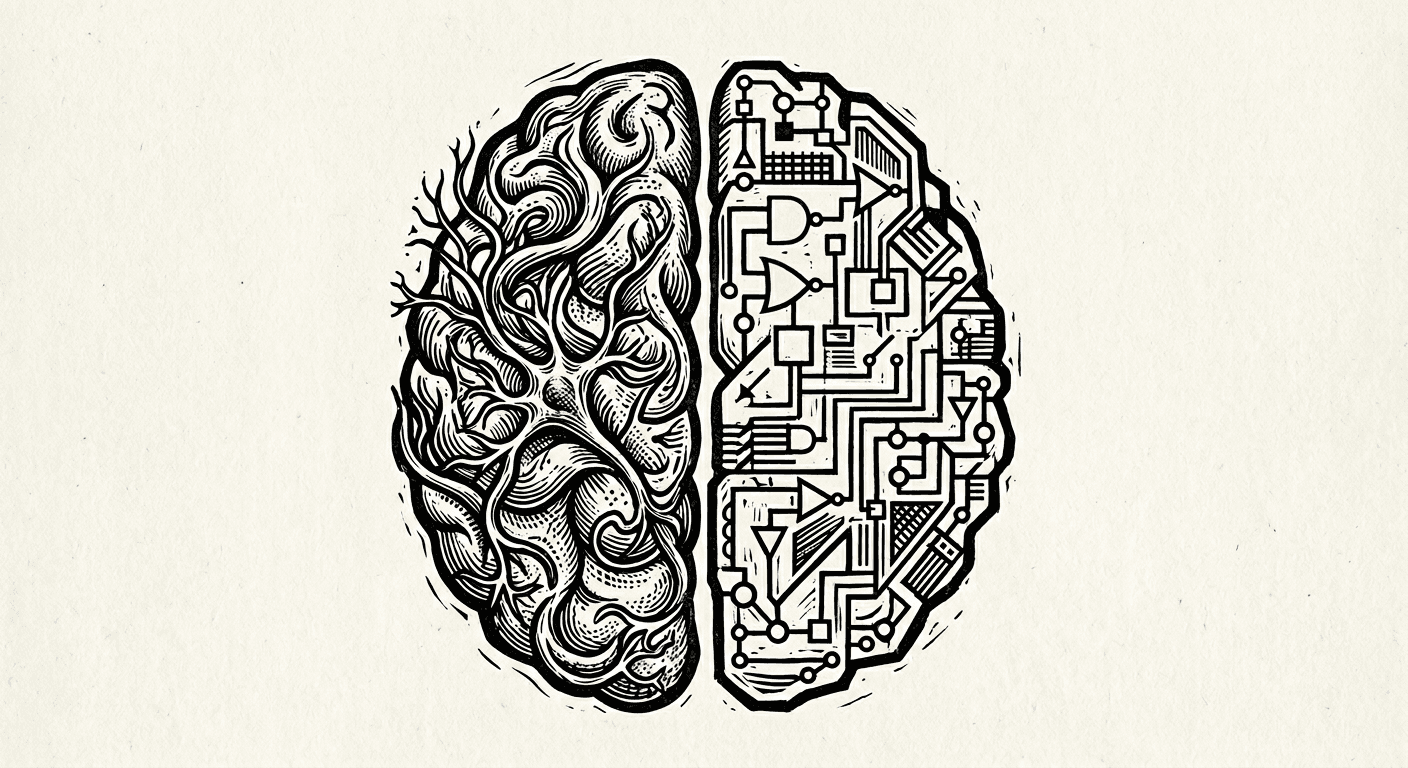
What Is Neuro-Symbolic AI?
Neuro-symbolic AI is a class of artificial intelligence that combines two families of technique. The neural side uses deep learning and large language models to handle perception, language, and pattern recognition. The symbolic side uses knowledge graphs, logic rules, and classical algorithms to handle structured reasoning, rigorous calculation, and explainable decisions.
The short version: LLMs handle the fuzzy parts. Symbolic systems handle the parts that must be correct.
The approach is not new. Symbolic AI dominated the field from the 1960s through the 1980s, failed to scale, and was largely displaced by the neural network revolution of the 2010s. What changed recently is that the neural side has matured enough to carry its weight, and researchers have proven that the neural side alone cannot solve every enterprise problem. The combination is gaining real traction in production systems.
Jacob Andra, CEO of Talbot West, framed it on The Security Podcast of Silicon Valley. "LLMs are not the whole of AI. They are one tool. You build real enterprise AI by composing multiple types of AI, each doing what it is good at."
Why LLMs Alone Hit a Wall in the Enterprise
Large language models produce fluent text and convincing summaries, and they have unlocked real value in document retrieval, customer support, and developer productivity. They also have consistent, repeatable failure modes when deployed as the only AI layer in an enterprise workflow.
Three failure modes show up across mid-market and enterprise deployments:
Hallucination on factual questions. The model predicts a plausible-sounding answer that is wrong. It does this whether the question is about internal policy, regulatory requirements, or financial data.
Inconsistent reasoning across attempts. Ask the same LLM the same question twice with small rewording, and you get different answers. For tasks that require a repeatable decision, this is a compliance blocker.
No ability to explain a decision in terms a regulator will accept. An LLM's answer is an emergent property of billions of parameters. "The model said so" is not an audit trail.
Stephen Karafiath, technical co-founder of Talbot West and a 30-year veteran of enterprise software at GE and Oracle, was direct about the limitation. "When the result has to be right, and the result has to be explainable, an LLM by itself will disappoint you. We saw this in the Oracle days too. The technology changes. The rules about what you can ship to a regulated business do not."
The symptoms match what security teams already see in agentic AI deployments where LLM-driven agents take inconsistent actions and leave no clean trail of why.
The Structural Failures That Scaling LLMs Will Not Fix
A common response to LLM failures is "we just need a bigger model." Research published in 2025 makes clear that bigger models do not fix the fundamental problem.
A February 2025 paper, "Hallucination is Inevitable: An Innate Limitation of Large Language Models" (arxiv 2401.11817), proves using computability theory that LLMs cannot learn every computable function. Some outputs will always be wrong, regardless of model size. Hallucination is not a bug to be tuned out. It is a mathematical property of the class of models.
A November 2025 paper, "On the Fundamental Limits of LLMs at Scale" (arxiv 2511.12869), extends the argument using information theory and shows that hallucination rates are bounded from below by properties of the training distribution itself. Scaling improves average quality but cannot drive hallucination to zero.
Andra summarized the research take. "The belief that a large enough LLM will solve reasoning is a comforting story. The math says otherwise. If your business depends on a correct answer, you need a system that knows how to ground itself in something besides probability."
This is the gap that neuro-symbolic AI exists to fill.
How Symbolic Reasoning Fills the Gaps LLMs Leave
A neuro-symbolic system uses the LLM where the LLM is strong and hands off to a symbolic layer where the LLM is weak. A typical enterprise pattern looks like this:
Step 1: Natural language interface. The user asks a question in plain language. An LLM parses the question, identifies the entities, and routes to the right reasoning pipeline.
Step 2: Structured retrieval. A knowledge graph or database returns facts relevant to the query. The LLM does not invent the facts; it retrieves them.
Step 3: Symbolic reasoning. A rules engine, a Bayesian model, a linear solver, or a graph traversal applies the facts against the business logic. The output is deterministic. The same input always produces the same output.
Step 4: Natural language output. The LLM explains the symbolic result in plain language for the user, with citations back to the facts used.
Every step has an audit trail. The facts came from a specific source. The rule that was applied is named. The numeric result is reproducible. The LLM is only responsible for the language, which it is genuinely good at.
Karafiath described his own example from Oracle. "We ran Bayesian fraud detection against banking transactions in the 1990s. It worked because the numeric decision was statistical and the explanation was rule-based. Replace the LLM for that whole stack, and you lose the guarantees. Wrap an LLM around the Bayesian model as a user interface, and you keep the guarantees and gain a natural language layer. That is the neuro-symbolic pattern."
The same decomposition applies to AI code generation workflows where LLMs write code but deterministic static analysis must verify it before merge.
Where Neuro-Symbolic AI Is Already Working
The architecture is not theoretical. It is running in production at scale.
Amazon Vulcan warehouse robots (2025). Amazon deployed a neuro-symbolic stack on its Vulcan robots that combines deep learning for perception (seeing the objects) with symbolic planning for manipulation (deciding how to grasp and place). The symbolic planner handles physical constraints that a pure neural approach would fail to respect consistently.
Amazon Rufus shopping assistant (2025). Rufus uses an LLM front end for conversation and a symbolic back end for product attribute matching and availability. The symbolic layer is why Rufus can answer "find me a waterproof jacket under $80 in stock in my size" reliably instead of hallucinating a product that does not exist.
IBM Research neuro-symbolic program. IBM's active research and enterprise work spans knowledge base question answering, automatic data science, compliance, and financial risk. A 2023 Nature Machine Intelligence study reported a 40% improvement in interpretability over pure neural networks for the same tasks.
Fraud detection and financial risk. Bayesian and symbolic systems have dominated this category for decades. The 2025 pattern is to add an LLM front end for investigator workflows while keeping the symbolic math underneath.
Identity and anti-deepfake systems. Detection systems that must say "this is a deepfake" with an audit trail combine neural feature extraction with symbolic policy rules. The pattern mirrors the architectural argument in identity proofing over deepfake detection where the provable claim matters more than the probabilistic score.
The common thread is enterprise risk. The higher the cost of a wrong answer, the more the neuro-symbolic pattern wins over LLM-only.
Building an Ensemble AI Stack Without Starting Over
Adopting neuro-symbolic AI does not require abandoning existing LLM investments or ripping out production AI. Four practical moves let a team add symbolic capability where it matters most:
Identify the failure surface. Where is the current LLM stack producing wrong answers, inconsistent results, or unexplainable decisions? That failure surface is where symbolic reasoning earns its keep.
Add a knowledge graph or structured data layer. Many "hallucination" problems are actually "no grounding data" problems. A knowledge graph of your products, policies, or rules gives the LLM something concrete to cite.
Introduce a symbolic verifier after the LLM. For high-stakes outputs, run the LLM's answer through a rules engine or constraint solver that can reject answers that violate business logic. This turns the LLM into a proposer and the symbolic layer into a judge.
Keep the LLM in the interface layer. Humans like natural language. The LLM is excellent at it. Preserve that advantage while moving the decision logic to a system that can be audited.
The same ensemble logic applies to authorization systems where LLM-driven policy authoring is paired with deterministic policy evaluation. The LLM drafts. The deterministic engine decides.
Andra closed the episode with a test that applies cleanly to any enterprise AI decision. "If you cannot explain why the answer is right, and you cannot reproduce it, you are not ready to ship it. The tool for that is not a bigger LLM. The tool is a stack that knows what each part is doing."
Listen to the Full Episode
Jacob Andra and Stephen Karafiath joined Jon McLachlan (co-founder of YSecurity and Cyberbase.ai) and Sasha Sinkevich (co-founder of YSecurity and Cyberbase.ai) on The Security Podcast of Silicon Valley to argue that LLMs are one tool in an ensemble, not the whole stack, and to walk through the enterprise patterns where neuro-symbolic AI is already producing results.
The conversation covers LLM structural limits, the history of symbolic AI, the CHAI ensemble framework developed at Talbot West, and the production deployments at Amazon and IBM that make neuro-symbolic AI a practical choice today.
What is neuro-symbolic AI in plain terms?
How is neuro-symbolic AI different from large language models?
What enterprise problems does neuro-symbolic AI actually solve?
Is neuro-symbolic AI already in production anywhere?
Security as a growth engine, not a tax
Submit a Security Request
Meet the hosts