Counter-Drone Technology: Why Small Drones Are the Biggest Gap in National Security
Small drone swarms are reshaping warfare. A defense tech founder explains why counter-drone detection and defeat is the most urgent gap in national security.
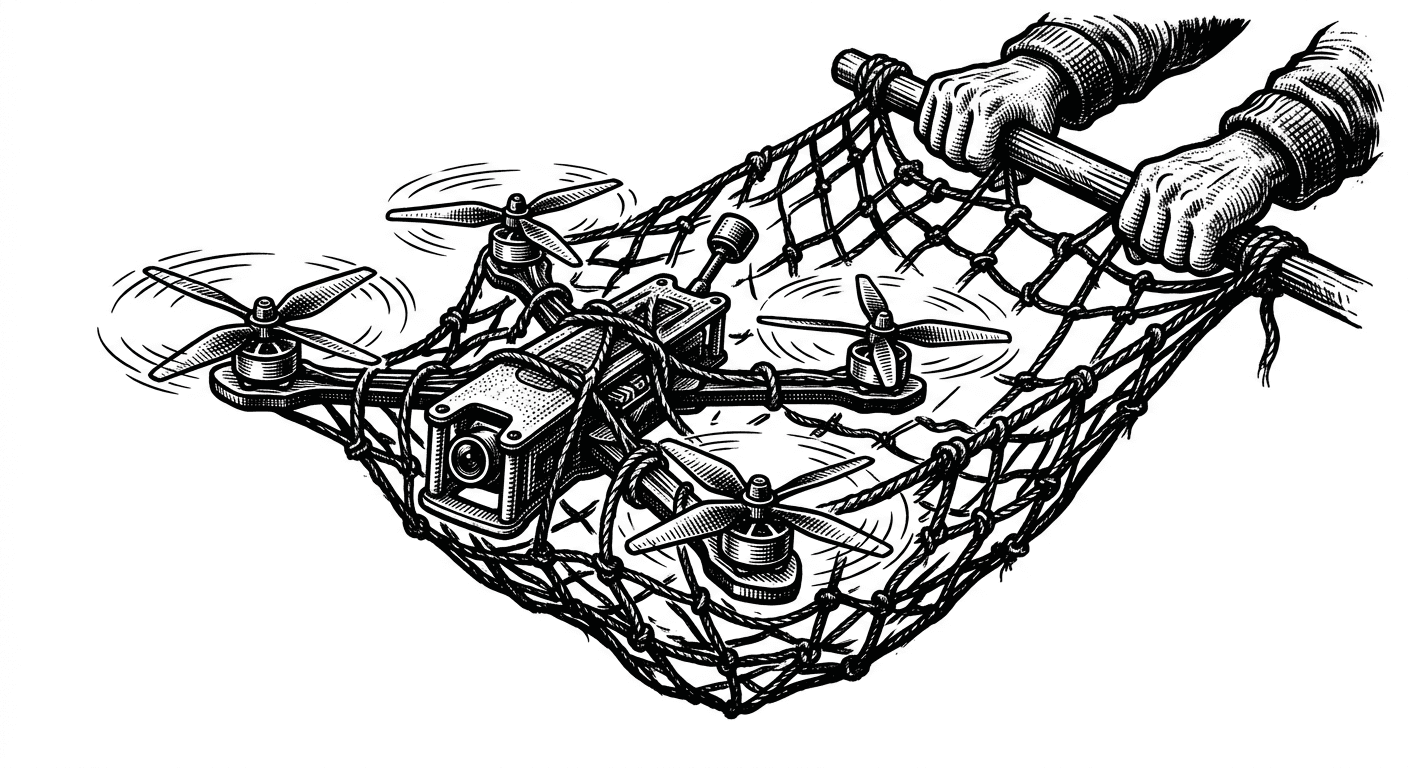
Small Drones Changed Warfare Overnight
Counter-drone technology is now the most urgent gap in national security. Every day, footage from the Ukraine-Russia front shows small drones used as one-way attack munitions, destroying tanks, infrastructure, and lives at industrial scale. The cost to the attacker is minimal. The cost to the target can be catastrophic.
This is not a future threat. It is happening now, and Western nations do not have adequate defenses against it.
How We Got Here: From ISIS to Industrial-Scale Drone Warfare
The evolution of weaponized small drones followed a clear escalation path.
ISIS first used small commercial drones as improvised weapons in Iraq and Syria in the early 2010s. The scale was small, the tactics were crude, but it proved the concept: a cheap drone could deliver a grenade with surprising precision.
The Armenia-Azerbaijan conflict in 2020 marked the next step. Turkish-made Bayraktar TB2 drones destroyed Armenian tanks and air defense systems. For the first time, a small nation demonstrated that drones could neutralize major military assets that cost millions of dollars.
Ukraine-Russia brought drone warfare to true industrial scale. Both sides now use thousands of first-person-view (FPV) drones daily. These small, cheap, expendable aircraft carry explosive payloads and are guided by operators who fly them directly into targets. A $500 drone can destroy a $10 million tank.
Garrett Smith, founder and CEO of Reveal Technology and a Marine Corps Reserve Lieutenant Colonel, called this the single biggest technology gap in national defense. "Every day we see highlight videos from the Ukraine-Russia front where small drones are being used as one-way attack munitions to kill people, destroy lives, destroy infrastructure," Smith said on The Security Podcast of Silicon Valley.
The Counter-Drone Problem Stack
Stopping a small drone is harder than it sounds. The problem breaks down into layers, and most existing solutions only address part of the stack.
Layer | Challenge |
|---|---|
Detection | Small drones have minimal radar signatures and can fly low to avoid sensors |
Tracking | Swarms of dozens or hundreds of drones overwhelm single-target tracking systems |
Identification | Distinguishing hostile drones from friendly or civilian aircraft in real time |
Defeat | Physically or electronically neutralizing drones before they reach their target |
Each layer requires different technology. Radio frequency (RF) sensors can detect drone control signals. Radar systems optimized for small targets can track them. Electronic warfare (EW) systems can jam control links or GPS. Kinetic systems, from directed energy weapons to interceptor drones, can destroy them.
The hard part is integrating all of these into a system that works against swarms, not just individual drones. A single FPV drone is a nuisance. A coordinated swarm of 50 is a serious military problem. A semi-autonomous swarm of 500 is something no currently deployed system can reliably stop.
This Is Not Just a Military Problem
The same drone tactics being used in Ukraine could target critical infrastructure anywhere. Smith pointed to a specific example: Ukraine used trucks to transport drones behind Russian lines, then launched semi-autonomous attacks against military assets deep in enemy territory.
"That could happen for critical infrastructure here in middle America," Smith said. "There are civil and military infrastructure projects here that are highly vulnerable to that kind of an attack and disruption, and it doesn't cost very much money for an adversary to do it."
Power grids, water treatment plants, oil pipelines, communication towers: all of these are potential targets for low-cost drone attacks. Traditional perimeter security, the kind that relies on fences, cameras, and guard posts, was not designed for airborne threats that cost less than a smartphone.
What the West Needs to Build
The counter-drone technology market is growing fast, but Garrett Smith argues that adequate solutions do not exist yet. What is needed falls into three categories.
Better detection at the edge. Current drone detection systems are often designed for airports or military bases with fixed infrastructure. The tactical edge, where soldiers operate in remote and austere environments, needs mobile, low-power detection that works on handheld devices or small vehicles.
Integrated defeat systems. A detection system without a defeat mechanism is an expensive alarm bell. The West needs tightly integrated systems that can detect, track, and neutralize threats in a single workflow, fast enough to handle swarms.
Scalable, affordable countermeasures. The economics of drone warfare favor the attacker. If a $500 drone requires a $100,000 missile to shoot down, the math does not work. Counter-drone systems need to bring the cost-per-engagement down dramatically, whether through electronic warfare, directed energy, or low-cost interceptor drones.
Reveal Technology, which builds mobile-optimized software for tactical military users, plans to expand into electronic warfare and signals capabilities, including network and cybersecurity tools designed for edge environments. Smith sees this as a natural extension of solving problems at the point where they actually occur.
The $125 Billion Signal
Venture capital has noticed the opportunity. From 2020 to 2024, investors put $125 billion into defense and dual-use technology companies, tripling the $40 billion invested in the prior four-year period. Much of that went to companies building autonomous systems, space capabilities, and software platforms for the military.
Counter-drone technology sits at the intersection of several hot investment areas: autonomy, electronic warfare, sensor fusion, and edge computing. Founders who can solve even one layer of the counter-drone stack, and do it at a price point the military can scale, have a clear market opportunity.
The challenge, as with all defense startups, is the long road to procurement. But as Smith and Reveal Technology have demonstrated, building from the tactical edge upward can shorten that road considerably.
Listen to the Episode
Garrett Smith shared his full perspective on Episode 90 of The Security Podcast of Silicon Valley, hosted by Jon McLachlan (co-founder of YSecurity and Cyberbase.ai) and Sasha Sinkevich (co-founder of YSecurity and Cyberbase.ai). Smith discusses how he and his co-founders built Reveal Technology from combat experience, why bottom-up product design wins in defense, and what keeps him focused on this mission after 21 years in the Marines.
Listen to the full episode for the complete conversation on why the defense tech renaissance is creating one of the most meaningful market opportunities for entrepreneurs today.
What is counter-drone technology?
Why are small drones a national security threat?
What counter-drone capabilities are needed most?
Can small drones threaten critical infrastructure in the United States?
Security as a growth engine, not a tax
Submit a Security Request
Meet the hosts